


JACKSON, Wyo. – The first of two storms will bring heavy snow to the Tetons and the Jackson Hole Valley from Thursday afternoon to Saturday. Another storm will bring more snow on Sunday and Monday. Temperatures will also moderate during this storm cycle following a mid-week cold snap.
Recent Weather Conditions
February has been a wild ride so far. In last week’s post, we discussed the atmospheric river event that brought heavy, wet snow to the Tetons, unseasonably warm temperatures, and heavy rain to the Jackson Hole Valley.
Another storm brought heavy snow to the Tetons late last week (February 7-9) with three-day snow totals of 15-19 inches at Jackson Hole Mountain Resort and 22 inches at Grand Targhee.
This storm featured another warm-up with Jackson picking up 3 inches of snow on Thursday evening before snow turned to rain on Friday morning.
This was a shorter-lived and lighter rain event for town with 0.18 inches of rain recorded over 5-6 hours before a cold front moved through and rain turned back to snow. Jackson picked up an additional 1.2 inches of snow after the changeover occurred.
Light snow showers continued on Sunday and Monday, followed by the arrival of arctic air on Tuesday and Wednesday.
On Wednesday morning, the temperature fell to -9ºF in Jackson which was the first subzero reading this month. By comparison, during January the temperature fell below zero in Jackson on 17 days.
Despite the colder past few days, for the month as a whole, temperatures are running well above normal thanks to the unseasonable warmth early this month.
The boundary between warmer temperatures to the south and colder temperatures to the north has been substantial so far in February. Temperatures in Western Wyoming have been 5 to 10ºF above normal so far in February, while in Montana, temperatures have been 10 to 20º below normal!
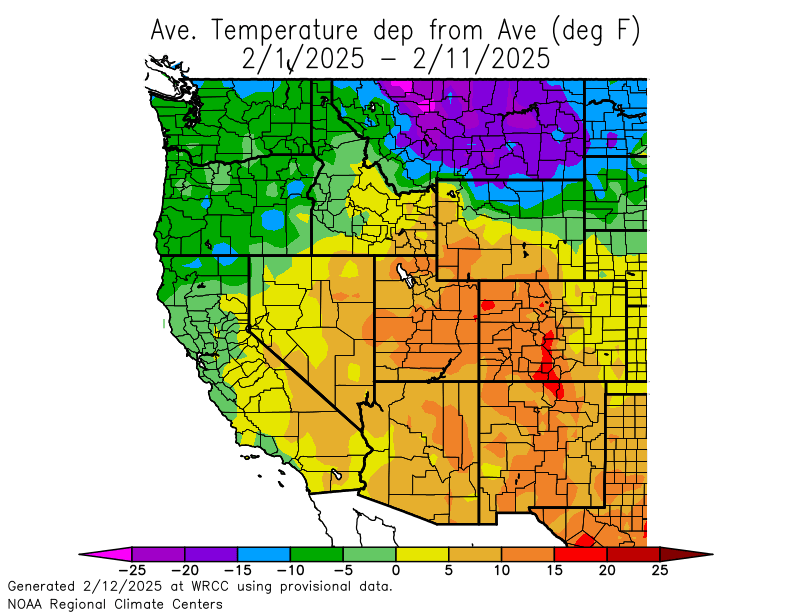
Moisture from the early February storm cycles has also been significant. So far this month, the town of Jackson has already received 2.72 inches of precipitation (rain and liquid-equivalent snow), making this by far the wettest month in town since March 2024 when we received 3.57 inches. And we are not even halfway through this month yet either.
Check out the precipitation anomaly for the Western U.S. so far in February. You can clearly see the favored position of the subtropical moisture plume associated with the atmospheric river from earlier this month.

In terms of snow water equivalent (the amount of water in the snowpack), the early February storms provided a major boost to the mountain snowpack. In the Upper Snake River Basin, snowpack is now right around average.

Snow depth (the height of the snowpack) is near to just slightly below average in most locations in the Tetons, with current snow depths of 80-90 inches above 8,500 feet.
In the town of Jackson, we lost a lot of snowpack during the early February thaw event, but have since gained back several inches. The current snow depth sits at 7 inches in town, which is about half of what is considered normal at this time of year (average snow depth for the date is 14 inches).
Upcoming Weather Pattern
Get ready for a lot of snow for the holiday weekend.
A strong storm will arrive on Thursday afternoon with heavy snow beginning across the region just in time for the Thursday evening commute.
This will be a large storm that will impact a significant portion of the Western U.S. On Thursday afternoon/evening, warm air aloft will move into our region from the southwest (referred to as warm air advection) and will interact with the arctic airmass in place.
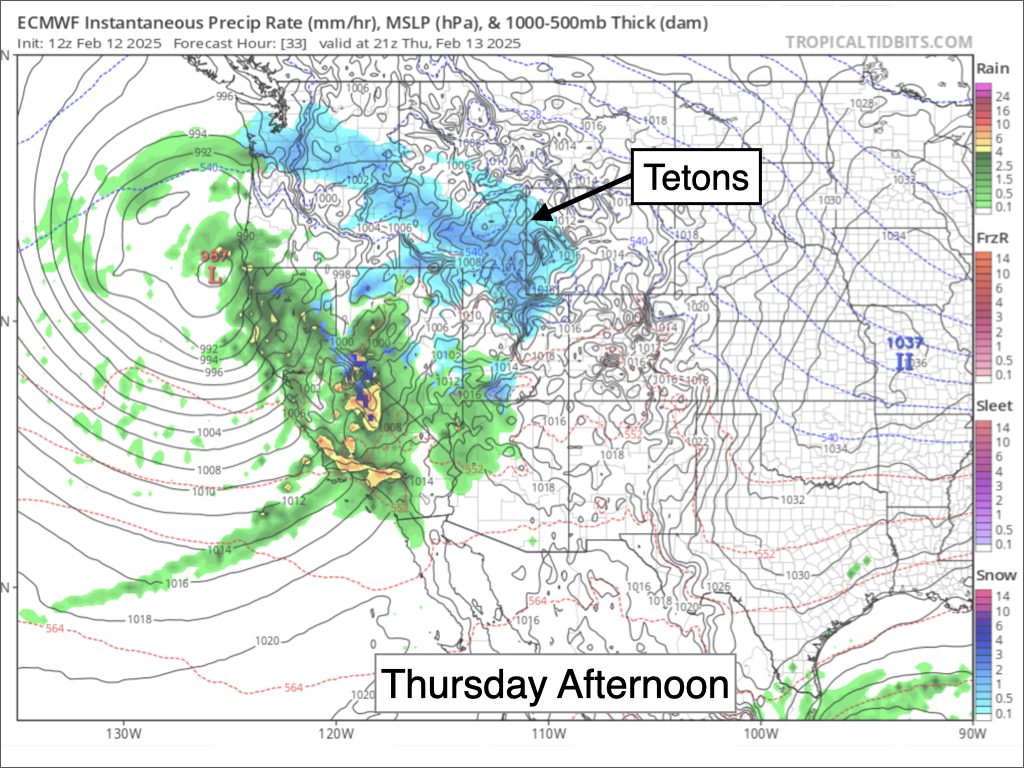
Cold air is denser than warm air, so this warmer air will move up and over the colder air as if it were on a ramp, leading to an acceleration in vertical lift which will lead to heavy snowfall rates in the mountains and in the valley.
The Jackson Hole Valley will see its heaviest snowfall rates of the entire event on Thursday night and into Friday morning, and a slow commute is likely throughout the region on Friday morning.
From Friday morning through about midday Saturday, snowfall will become more terrain-driven (orographic) in nature with heavy snow continuing to pile up over the Tetons, while the valley will see lighter and more intermittent snowfall.
A break in the action will occur from later Saturday afternoon and into Saturday night, and then another storm will arrive on Sunday.
While the core of the previous storm will have taken a track from California into the Central Rockies, this next storm on Sunday and Monday will move into our area from the Pacific Northwest.
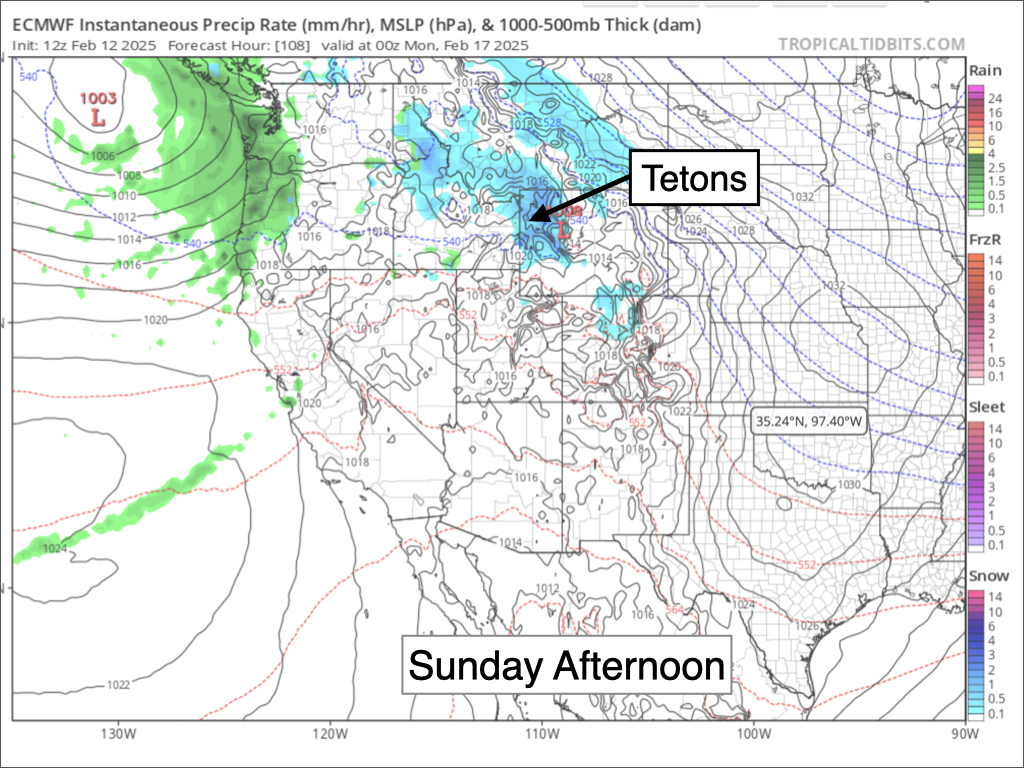
This storm will likely not be as strong as the Thursday-Saturday storm, but it will still produce a good amount of snowfall across the area with more powder for skiers, along with headaches for travel.
For skiing, these back-to-back storms with more seasonal temperatures and comparatively lighter winds will make for excellent conditions… if only it weren’t happening on the busiest weekend of the season outside of Christmas-New Year’s week!

In addition to snowfall, temperatures will be much more comfortable during this cycle following the mid-week cold snap. Highs will generally reach the low 30s in the valleys most days with lows in the 20s… warm enough to be comfortable but not so warm that we have to worry about rain.
Looking further out, another weaker storm is possible around February 19-20. This is still a week away so confidence in the details is low at this time.
From February 21 through roughly the end of the month, weather models have been in good general agreement with a ridge of high pressure building over the Western U.S., which would favor warmer and drier conditions with fewer opportunities for snow.
Alan Smith, Meteorologist










