JACKSON, Wyo. – The town of Jackson received 11.2 inches of snow over the weekend followed by nearly an inch of rain on Sunday-Monday. From Sunday to Wednesday, temperatures were above freezing for 77 consecutive hours with a high of 54ºF occurring on Tuesday.
Storm Produces Heavy Valley Snow Followed by a Major Thaw
Following a dry January with well below normal snowfall, a storm cycle from January 31 to February 3 produced substantial impacts across Western Wyoming.
This storm involved an atmospheric river, which is a narrow plume of subtropical moisture that can bring signififcant moisture, high winds, and often mild temperatures. In the past, this was more commonly referred to as a “pineapple express”.
This past weekend’s storm came in a few different waves.
From Friday night to Saturday morning, widespread heavy snow fell across the region followed by more intermittent (but often heavy) snow from Saturday morning to Sunday morning.
Temperatures were much warmer compared to prior weeks in this initial part of the storm cycle, but cold enough for snow levels to remain on the valley floor.
The town of Jackson picked up a total of 11.2 inches of snow from Friday night to Sunday morning, which was almost double the amount of snow that fell during the entire month of January (6.9 inches).
On Sunday morning, around 9:30 am, snow changed to rain in Jackson as a surge of warm air associated with the strongest part of the storm cycle arrived. Rain then fell in town for about 24 hours through mid-morning Monday with a total of 0.87 inches of rainfall recorded.
This was the heaviest mid-winter rain event (December-February) in town since February 2017 when about 1.57 inches of rain fell over three days from February 7-10, during the same storm cycle that knocked out power to Teton Village for five days.
Snow levels (the rain/snow line) rose as high as 7,500-8,000 feet in the Tetons on Sunday afternoon and evening which is quite high for this time of year.

Another weaker storm arrived on Wednesday morning, and this also resulted in rain in the town of Jackson with a total of 0.22 inches recorded.
Through the first 5 days of February, the town of Jackson has already received 2.07 inches of precipitation (rain and liquid-equivalent snow) which already makes this the wettest month in town since last May, and we’re only five days in!
Spring-Like Temperatures in Early February
The rain event on Sunday and Monday was the start of an extended warm spell, in which temperatures remained above freezing in town for 77 straight hours… from 9:00 am on Sunday through 2:00 pm on Wednesday.
Tuesday was the warmest day when temperatures were in the upper 40s at daybreak, and the high temperature peaked at 54ºF in the town of Jackson – the warmest February day in 10 years (we high 55ºF in town in February 2015).
Here is a 24-hour temperature chart from Tuesday…

As warm as it was, this temperature did not set a record. The record high for thate date was 57ºF and the all-time record high for the month of February is 58ºF.
The heavy rain event followed by the warmth led to substantial snowmelt in the town of Jackson.
Snow depth in town (the height of the of settled snow on the ground) rose from 9 inches to 17 inches during the weekend snow event, before falling to 6 inches by Tuesday morning.
There has not been an updated snow depth reading on Wednesday, but significant melting occured on Tuesday afternoon and I would estimate we are down to 3-4 inches in town (on average).
On average, snow depth in town on February 5 is about 15 inches. During the previous 6 winters (2019 to 2024) we had at least 13 inches of snow on the ground on February 5, with a high of 33 inches of snow depth on February 5, 2019.
The last time we had less snow on February 5 than what we currently have now was in 2018. That was a very mild winter and we also experienced unseasonable warmth in early February that melted away most of the snowpack.
One difference in 2018 is that snowpack was already low before early February, and that year, we had a streak with 7 out of 8 days with high temperatures above 40ºF – a longer but less extreme warm snap than what just occured.
Rain did fall during the 2018 thaw event, but only light amounts. However, snowpack almost disappeared entirely, before a pattern change in mid-month brough colder and snowier conditions during the second half of February and March.
Another (relatively) recent February thaw event occured in 2015 when we experienced unseasonable warmth along with some rain.
During February 2015, snow depth values hit zero by mid-month and a prolonged warm and dry spell continued through the end of the month with official snow depth remaining at zero. Spring truly arrived early that year!
Significant Moisture and Snowfall for the Tetons
This was a significant storm cycle for the Tetons, with snow totals above 8,000 feet ranging from 20 to 32 inches from January 31 through the morning of February 4. Strong winds also occured througout this cycle with peaks gusts of 70-80 mph above 9,500 feet on Sunday night.
The warmth also impacted the higher elevations during this cycle. While the initial snowfall from Friday night to Saturday was “medium density”, as temperatures rose, the snowfall become extremely wet on Sunday and Monday.
Snow-liquid ratios during the Sunday-Monday round were around 5 to 1 (20% density), which is more reminsicent of “Sierra cement” or “Cascade concrete”.
Snow water equivalent totals ranged from 3.88 to 4.61 inches at Jackson Hole Mountain Resort over four days, which is an incredible amount of moisture.
Also, freezing levels rose to 9,500-10,000 feet in the Tetons after the storm and areas below these altitudes did not see a freeze on Monday night/Tuesday morning. In other words, snowpack and skiing conditions have been adversely impacted even up high.
Remote snow telemetry stations around the region record the total amount of snow water equivalent in the snowpack at a given time, and this data is used to compare current season values to past season values as an evaluation tool for snowpack health.
After the substantial increase in snow water equivalent from this cycle, our mountain snowpack in the Upper Snake River Basin has improved to 99% of average, which is a big jump from this time last week.

In terms of snow depth (the height of the snow cover on the ground), we are still slightly below average in the Tetons as this last cycle was very wet with low snow-liquid ratios… the amount of snowfall and the increase in snow depth was less significant relative to the increase in snow water equivalent.
In the lower valleys below 6,500 feet, snow depth measurements are very limited, but the lower snowpack did take a hit from this warm spell compared to up high.
Regardless, this storm has brought beneficial moisture to our region considering we are currently in a drought.
Upcoming Weather Pattern
Winter is set to return in the near future…
A cold front moved through on Wednesday afternoon, ending the above-freezing temperature streak in the town of Jackson around 2 p.m.
Snowfall was insignificant with this storm, but a substantial cool-down will occur on Wednesday night and Thursday in the wake of the cold. Dangerous icy conditions will occur around town as all of the melt water and slush re-freeze into solid ice.
Also, skiing conditions will be icy and treacherous, especially below 8,000 feet (but possibly even much higher than that).
From Thursday night to Saturday morning, a stronger storm will impact the area with heavy snow for the Tetons.
Heavy snow will also fall at times in the valley, but if you can believe it, a period of rain is likely during the warm sector of the storm from mid-morning to early afternoon on Friday. Snow levels could potentially peak as high as 7,000 feet during this time.
Fortunately, this rain will be much shorter lived and will turn back to snow later on Friday afternoon as a cold front moves through, with light accumulations expected on Friday night.
On Saturday, much colder air will arrive and will hang around through at least the middle of next week. Icy conditions may return to the valley (depending on how much snow falls on Friday night), while skiing conditions should be much improved.
Occasional weaker disturbances could also move through this weekend and next week with light terrain-driven snow showers possible at times.
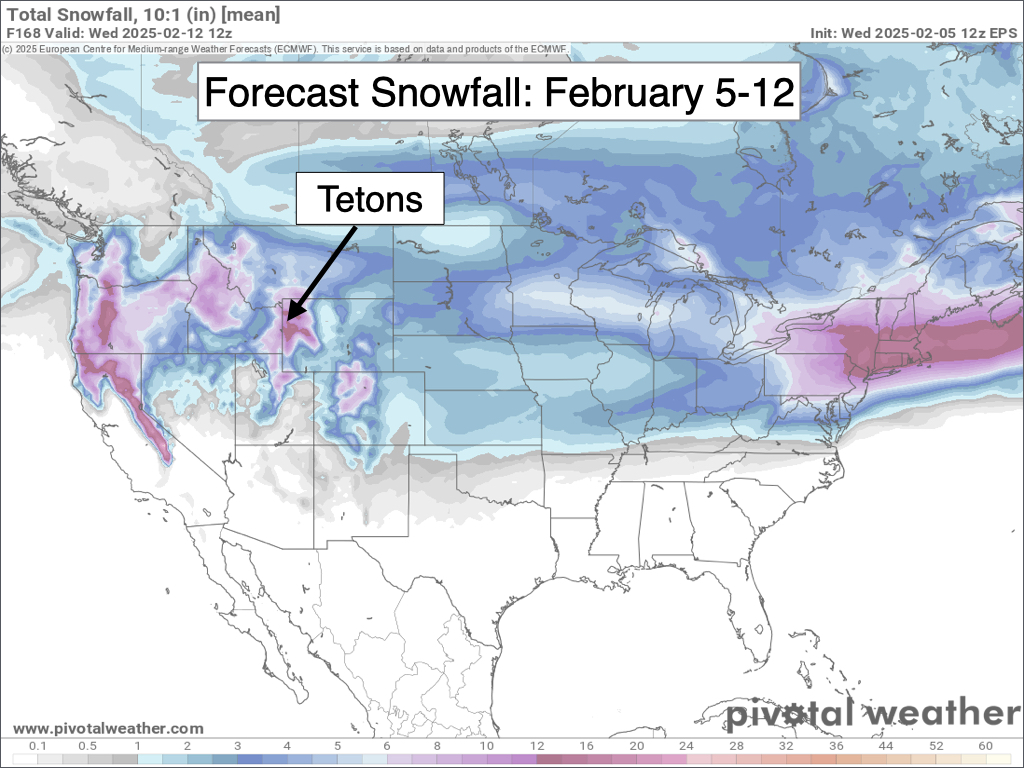
Starting around February 12-13, there are hints that we could head back into a more active pattern with stronger storms possible. There are no signs of any substantial warm-ups either, so hopefully these storms would bring more seasonal powder conditions rather than rain and wet snow.
Alan Smith, Meteorologist