YELLOWSTONE NATIONAL PARK — As the books close on 2023, the Yellowstone Volcano Observatory (YVO) is looking back at the year’s geological activity within Yellowstone National Park (YNP).
YVO is a consortium of nine state and federal agencies that monitor volcanic, hydrothermal and earthquake activity in the Yellowstone Plateau region. Michael Poland, geophysicist with the U.S. Geological Survey (USGS) and Scientist-in-Charge of YVO, wrote the first issue of the Yellowstone Caldera Chronicles of 2024, which summarizes the major seismic happenings in and around YNP.

With its world-famous geysers and canyons, YNP is known for being a volcanic hotspot. According to YVO, 2023 seismicity was on the lower end of the spectrum for the park, which typically sees between 1,500 and 2,500 earthquake events per year. In 2023, the University of Utah Seismograph Stations recorded about 1,600 earthquakes in the region, with the largest being a magnitude 3.7 event on March 29, 2023. Ninety-nine percent of those earthquakes were magnitude 2 or below.
About half of those earthquakes occurred in swarms, which are earthquakes that occur in the same area in rapid succession, YVO said. March 2023 saw two “significant” swarms: 147 quakes near West Yellowstone, MT, and 106 beneath northern Yellowstone Lake. Swarms “are generally driven by interactions between groundwater and existing faults,” according to the Chronicles.
YVO said geyser activity in 2023 “was also relatively calm,” noting that the nine major eruptions of Steamboat Geyser represent a continued decline in its eruption frequency. On the other hand, Giant Geyser erupted for the first time since 2019, on Nov. 23, 2023.
Other noteworthy happenings included the “hydrothermal unrest” recorded in early summer when new features formed on Geyser Hill.
“This resulted in part of the boardwalk in the area being closed to visitors—hot water and debris were splashing onto the walkway—but the activity soon waned, and the boardwalk was reopened by early August,” the Yellowstone Caldera Chronicles reads. “The sequence had some similarities to 2018 unrest in the same general area and is a good reminder of the dynamic nature of Yellowstone’s geyser basins.”
YVO researchers also shared that the formation date of Steamboat Geyser is being re-evaluated after dating wood fragments embedded in the geyser’s deposits. “The ages of the wood indicate that the geyser has been active for hundreds of years—far longer than the formation date of 1878 as claimed by Philetus Norris, second superintendent of Yellowstone National Park and namesake of Norris Geyser Basin,” the issue reads.
The observatory noted that ground deformation measurements, or geodesy, indicate ongoing subsidence of the caldera at the rate of 1 inch per year, a pattern observed since 2015.
Scientists have also been assessing new data concerning the magma chamber beneath the Yellowstone caldera, the result of hundreds of seismic stations deployed throughout YNP in 2020. They have found “that the top of the magma complex is characterized by horizontally elongated areas of localized magma storage, called sills, and that magma is stored in a sheet-like manner, instead of being evenly distributed within the rock matrix,” according to the publication. “After accounting for the textural fabrics, the melt fraction was estimated to be up to 28% in this region of the magma chamber.”
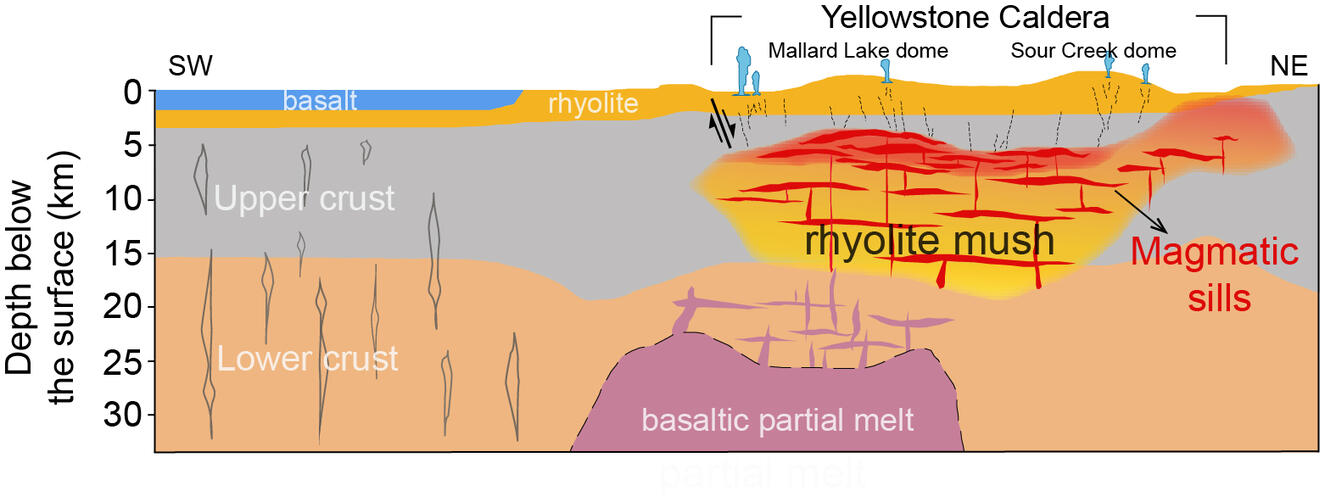
This new understanding of magna formation can be applied to future research and might improve eruption forecasts.
For more on the Yellowstone Volcano Observatory, see its website. Sign up to receive the Yellowstone Caldera Chronicles here.