JACKSON, Wyo. — Town Councilors made strides in determining new Land Development Regulations (LDRs) and design guidelines as they addressed goals of the
moratorium on large buildings during their regular Town Council meeting on Monday, August 5.
This discussion was a continuation from the July 19 Planning Commission/Town Council Joint Workshop and a series of draft readings and public hearings have been scheduled in August and September to help ensure that the Town puts new guidelines in place before the moratorium deadline of October 1. Councilor Jim Rooks said that the determination of building requirements and the preservation of Jackson’s character is Town Council’s most pressing and important issue.
During the meeting, Town Planning Director Paul Anthony presented the proposed LDR/design guideline changes for the Council to review. Mayor Hailey Morton Levinson reminded Councilors that public comments and official voting would be taken up at a future hearing. In lieu of formal voting, Councilors simply gave a thumbs up or thumbs down to each item on the list of proposed building requirements. The list of items in the redline draft included maximum building size, maximum facade length, Conditional Use Permit (CUP) requirements, 2:1 bonus modifications, design guidelines, maximum development site size and landscaping requirements.
In addressing maximum building size, it was an unanimous thumbs up for the restriction of 40,000 square feet for downtown and 50,000 square feet along the highway corridor. Staff recommended only counting the above-ground living space (not basements or garages) as part of the maximum building size, if the goal is to preserve town’s visual character. Councilors Jim Rooks and Jonathan Schechter countered that the entire habitable square footage needs to be taken into account, including basements, to properly mitigate environmental impacts.
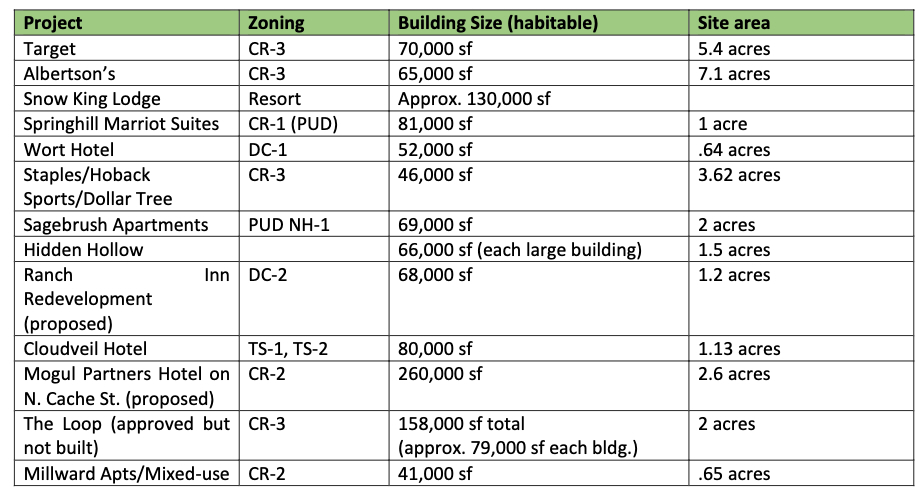
The below table provides the size of a number of familiar older and newer buildings for reference.
Councilor Arne Jorgensen said that the new size restrictions will allow for the construction of more boutique hotels, but he still had concerns that a “bunch of high-end condominium buildings,” which often sit empty, could continue to be developed. Rooks also suggested a minimum room number requirement for hotels so space isn’t taken up with meeting rooms, spas, gyms and other hotel amenities.
“This is an opportunity to close some loopholes for people coming here wanting to take advantage of this place,” Rooks said.
Town Councilors all gave a thumbs up for a maximum facade length of 150 to 200 feet, which is approximately four lots (about the size of The Cloudveil). They also unanimously agreed for the allowance of a CUP determination to address building use, historic preservation and impacts on ground water, storm water, traffic, wildlife and light pollution.
“A CUP is needed for projects with four lots to give more conditional level oversight of external impacts,” Jorgensen said.
Staff recommended that the 2:1 workforce bonus be modified to address bigger buildings. Town Councilors agreed that if a building is 40,000 square feet then it cannot be enlarged and therefore cannot qualify for the bonus. But smaller buildings (under 40,000 sq. feet) could still apply the 2:1 additional height bonus for deed restrictive housing. Jackson/Teton County Affordable Housing Department Director April Norton told Town Council that she does not recommend changes to the 2:1 ratio or required deed restrictions at this time.
All the Councilors agreed that building design guidelines, including landscaping, need more thorough clarification.
Rooks gave direction to staff to “add a live button on the Town’s website” so people can follow along with the entire informational process. Morton Levinson made a motion to continue the next phase of the LDR/design guideline review to the Town Council meeting on Monday, August 19, when public comments will also be considered.