JACKSON, Wyo. — During the Town of Jackson Workshop on Monday, Feb. 26, staff recommended updates to the Bear Resistant Trash and Wildlife Feeding Ordinance.
The Town Council discussed the potential next steps to provide bear resistant trash containers, and to curb wildlife feeding.
According to the Town, wildlife feeding regulations have been updated, and the feeding ordinance states that supplemental feeding to wildlife is prohibited. A Code Enforcement Officer is to respond to complaints that are filed regarding wildlife feeding.
“Intentional feeding of ungulates such as mule deer continues to occur annually in the winter in Upper Cache Creek and other locations,” Ecosystem Stewardship Administrator Tanya Anderson said during the retreat. “Feeding is harmful to ungulates whose guts adapt to a different winter diet, and whose presence in Town makes them more prone to vehicle collisions.”
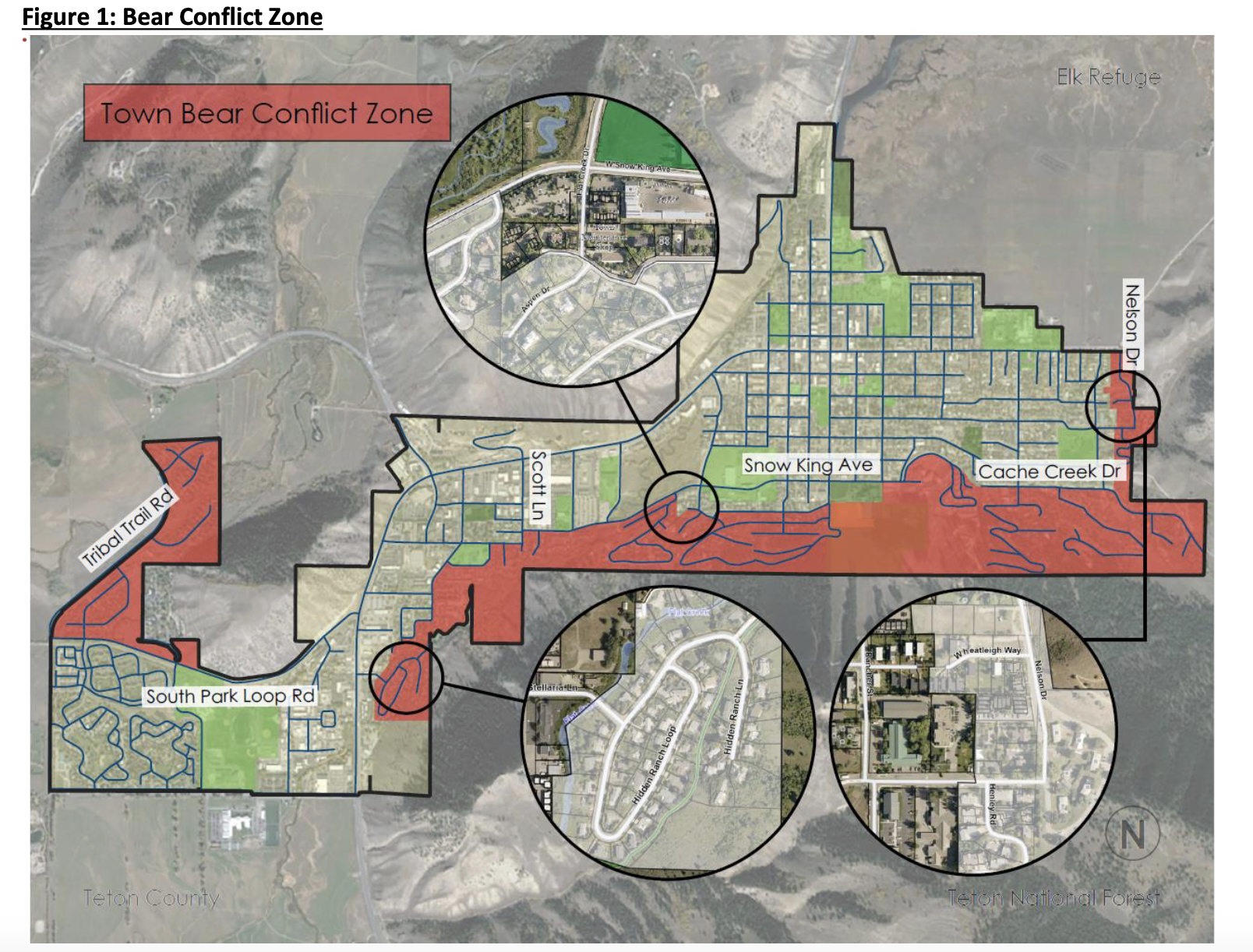
In 2023, the Town made the goal to convert 100% of Town-owned trash containers to bear-resistant ones within two years, and to expand the zone to protect bears throughout the entire town by 2030.
Wyoming Game and Fish Department (WGFD) staff reported that there were 77 bear conflicts in the Jackson Region (Teton County and Jackson) in 2023. Teton County averages 89 conflicts annually, so this is a reduction from typical years. Eleven bears were captured and relocated or euthanized due to conflicts. Ten of those conflicts involved trash and/or grease, and one involved getting into bird seed.
Within the Town of Jackson, there were four bear conflicts in 2023. Two of the conflicts were near Cache Creek, one was at the hospital and one was near downtown. Three conflicts involved bears getting into dumpsters, one involved an apple tree and one involved both residential trash and an ornamental chokecherry shrub. Two of the conflicts were resolved by securing the trash. One bear was captured and relocated. All conflicts within the Town of Jackson involved black bears.
The requirement for bear-resistant trash containers for residential and commercial properties within the designated Bear Conflict Zone went into effect on April 1, 2023.
In 2023, Town staff, in partnership with Wyoming Wildlife Advocates, Bear Wise Jackson Hole and Teton County, engaged in multiple public education and outreach efforts, including bilingual flyers, bilingual door hangers delivered to every residence within the Bear Conflict Zone, radio interviews and ads, press releases, e-newsletters and social media posts, website updates, booths at community events such as the EcoFair and classroom programs.
Bear resistant compliance rates increased following efforts to educate residents with tags that were placed on cans that were out-of-compliance.
Town estimates that 70% of residences and businesses within the Bear Conflict Zone have bear resistant trash containers. The County estimates that compliance rates were higher, approximately 97-99%, in areas that have had bear resistant trash requirements in place since 2009, and that lower compliance rates of 78% were calculated in areas where the bear resistant trash requirement went into effect in November 2022.
“Compliance varies greatly by neighborhood, and not all bear-resistant cans are being used correctly. There are multiple cases of ‘snowconing,’ where trash is overflowing and the container cannot be properly latched.”
Town and County communicated with Bear Wise Jackson Hole and waste haulers to devise ways to overcome compliance challenges.
The Town’s waste haulers reported that additional staff time is needed to replace old trash cans, the cost of purchasing new cans and dumpsters is expensive and visitors don’t always know how to use the bear-resistant cans or dump trash bags next to the can. Haulers stated that the majority of customers who are likely to comply voluntarily have already done so, and those remaining will be more difficult to bring into compliance.