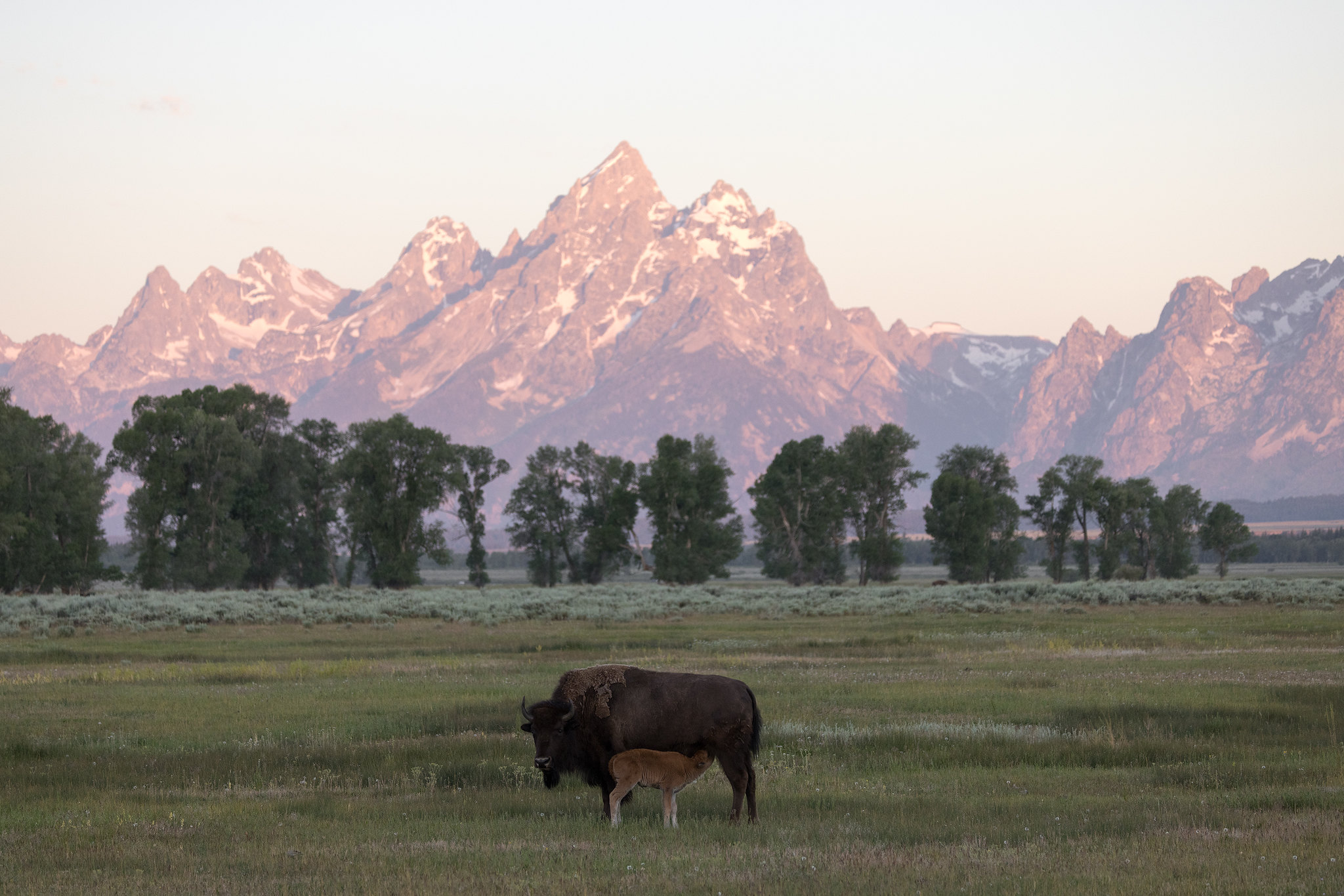
GRAND TETON NATIONAL PARK — The Grand Teton is perhaps the most recognizable peak in Grand Teton National Park (GTNP), but with 56 named mountains within Park boundaries, there are a number of notable peaks with a prominent place in both history and the storied landscape.
Below, Buckrail explores some of the peaks in GTNP from the south to the north that are most visible and popular to visitors, and their historic namesakes.
Albright Peak
According to the National Park Service (NPS), Albright Peak is named after its second director, Horace M. Albright. Born in 1890, Albright was a California native who moved to Washington, D.C., in 1913 to work for the Secretary of the Interior and then became a field director of the NPS until 1929, when he became director.
The NPS credits Albright as the man who introduced John D. Rockefeller, Jr. to what became GTNP in 1926. Albright founded visitor services and park museum programs within the NPS, and assisted in expanding the boundaries of GTNP, and was awarded the Presidential Medal of Freedom in 1980 for this work.
Buck Mountain
On August 21, 1898, surveyor T.M. Bannon made the first ascent of Buck Mountain and named it after his climbing partner and topographer George A. Buck. According to the Grand Teton Historic Resource Study, Bannon and Buck built a large cairn on the summit known as “Buck Station.”
Disappointment Peak
The American Alpine Club (AAC) credits the name of this peak to Phil Smith, who became one of the first seasonal park rangers in GTNP in the late 1920s. In 1925, Smith and his friend Walter Harvey attempted to climb the Grand Teton from Amphitheater Lake, where they found a 450-foot drop that presented an impasse to the saddle between the two summits. The men failed their rappel attempt and named the peak they did summit after their disappointment in not reaching the Grand.
Five days later, the AAC confirms the men successfully made the 14th ascent of the Grand Teton via the Owen-Spalding route.
Mount Owen
The second-highest peak in the Teton Range is named after William O. Owen, who the Wyoming Historical Society writes was a Laramie, Wyoming, native known to be a longtime land surveyor, avid outdoorsman and writer. Owen and two friends were the first to ever bicycle across Yellowstone National Park, an account he published in 1891, and in 1898 he published an article claiming to be part of the first party to ascend the Grand Teton; this was later contested by Nathaniel P. Langford.
Prospector’s Mountain
Named to celebrate the incredibly rare discovery of galena in Death Canyon, Prospector’s Mountain actually highlights the disappointing mining history in the area. Read more about the unsuccessful attempts to strike it rich and the uniqueness of Prospector’s history here.
Signal Mountain
According to GTNP, Signal Mountain refers to a highly suspicious death in the Park. In 1890, John Dudley Sargent and his partner Robert Ray Hamilton opened a lodge called Merymere Lodge overlooking Jackson Lake. In 1891, Hamilton went missing while out hunting. GTNP writes that searchers planned to light a signal fire on the summit of this mountain when Hamilton was found; his drowned body was discovered in the Snake River two miles below Jackson Lake Dam, a week after he disappeared.
GTNP claimed Sargent was a suspect in the death, in addition to being a suspect in the murder of his first wife.
Despite the darkness, Signal Mountain and the other peaks now represent the legacies of Jackson Hole in its earlier years.
Teewinot Mountain
The NPS translates Teewinot to mean “many pinnacles” in the New (Shoshone) language. The NPS writes that the name could have originally applied to the entire Teton Range. Fritiof Fryxell and Phil Smith named the single peak Teewinot after successfully completing the first ascent in 1929.
The NPS also credits Fryxell and Smith with initiating the practice of requiring climbers to check in with park authorities as a safety measure, reporting all new routes and climbs.
This story runs annually.