JACKSON, Wyo. – A powerful storm cycle will impact the Tetons from Friday night to Monday. This storm will involve a plume of subtropical moisture with heavy snow and strong winds, while a changeover to rain is possible over the lower elevations on Sunday and Monday.
Recent Weather Conditions
January is going to finish as a drier and colder-than-average month in Jackson. We have been in a long dry spell with just some occasional brief snow events since early in the month.
The last snow event occurred on Friday, January 24 with most areas in the Tetons picking up 1-4 inches, though Targhee came in higher with 8 inches.
The town of Jackson has only received 6.9 inches of snow this month… less than the amount of snow that has fallen in New Orleans this month! This is well below the January average of 20.5 inches.
In the Tetons, the Rendezvous Bowl Plot at Jackson Hole Mountain Resort will finish the month of January with 58 inches of snow, well below its January average of 90 inches. Targhee has done a little better this month with 71 inches total.
Snowpack in the Tetons and Upper Snake River Basin briefly caught up to average in early January, but as of January 29, snowpack is only 79% of average.
Following a mild start to the winter in terms of temperature, the second half of January has been much colder. Part of this is due to intrusions of arctic air from the north.
However, temperature inversions have also kept cold air locked into the Jackson Hole Valley for longer periods – especially this week, which has actually been pretty mild in the mountains.
With two days left in the month, temperatures are running 4.3 degrees below average in the town of Jackson with subzero temperatures recorded on 11 of the past 12 days.
Upcoming Weather Pattern
We have a major change headed our way late this week as the stubborn ridge of high pressure that has been in place over the Northwest U.S. will finally break down.
The first storm of this cycle will arrive late in the day on Friday, with heavy snow and strong winds expected from Friday night through Saturday night.
Temperatures will be relatively mild during this storm, but colder compared to what’s ahead later in the weekend. Heavy snow will fall in the mountains, but the valleys are also going to see significant snowfall totals during this period.
The next wave on Sunday and Monday will be stronger and more complex.
A long and relatively narrow plume of subtropical moisture known as an “atmospheric river” will impact our area during this time.
Atmospheric rivers are known for bringing substantial precipitation, mild temperatures, and strong winds to coastal mountain ranges, but occasionally they impact inland areas such as the Tetons.
This is projected to be a fairly substantial atmospheric river event by local standards. The image below shows integrated water vapor transport into the Tetons on Sunday evening with the plume of moisture originating from the subtropics (another term for this pattern is a “pineapple express”).

Warmer air will also move into Western Wyoming on Sunday and Monday, and this will result in rising temperatures and rising snow levels, along with heavy/wet snow.
From Sunday afternoon through Monday, rain is a strong possibility in the valleys, and snow levels (the rain/snow line) could potentially reach as high as 7,000 to 8,000 feet at times.
The image below shows projected temperature anomalies (in ºC) for Sunday evening from the European Model, with dark red/pink colors indicating well above average temperatures. There will be a sharp boundary between colder air to the north and warmer air to the south, but most weather models are projecting us to be on the warmer side.
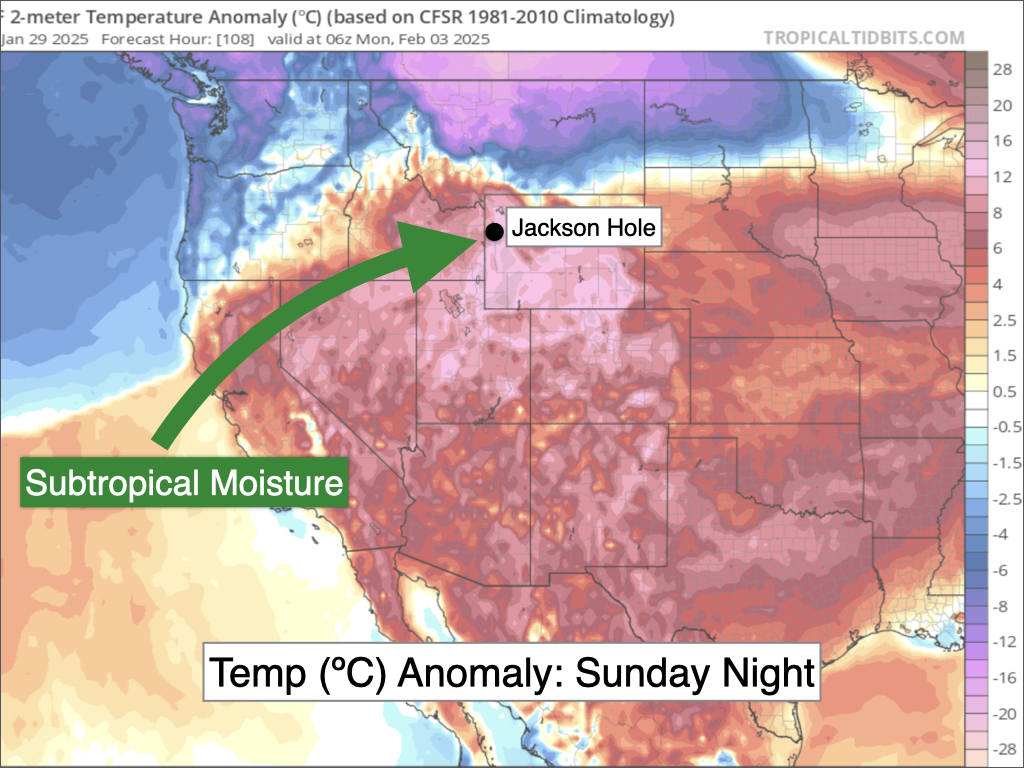
Sunday to Monday could potentially be a messy period with low-elevation rain or at least mixed precipitation, high-elevation wet/dense snow, and continued strong winds.
There is one model – the American GFS – that is projecting the colder air to push further south than the other models. This solution would result in temperatures staying cold enough for all-snow in the valleys.
The American GFS Model projection is an outlier at this time, as most other models are much warmer. But it does highlight the uncertainty of the forecast in the Sunday-Monday timeframe.
Beyond Monday, we will likely see additional waves of precipitation arrive through at least the middle of next week.
Temperatures may remain warm enough for rain or a rain/snow mix to continue across the lower elevations through Wednesday (February 5) with colder air returning later next week. But again, there’s at least a small chance we could see colder temperatures and low-elevation snow, rather than rain.
Regardless of which solutions play out, we are in line to receive a significant amount of moisture over the next 7-10 days.
The image below shows 10-day precipitation projections from 80 different weather model simulations (from the American GFS and European Model suites).
The average of these model simulations has 5 to 6 inches of liquid-equivalent precipitation at Jackson Hole’s Rendezvous Bowl Plot, which is a ton of moisture for our area!

Higher elevation terrain above 8,000-9,000 feet will see significant amounts of snow in this pattern, and it will likely be on the heavier/wetter side and wind-affected, making it not all that pleasant for skiing (unless the cold outlier model solution ends up being onto something).
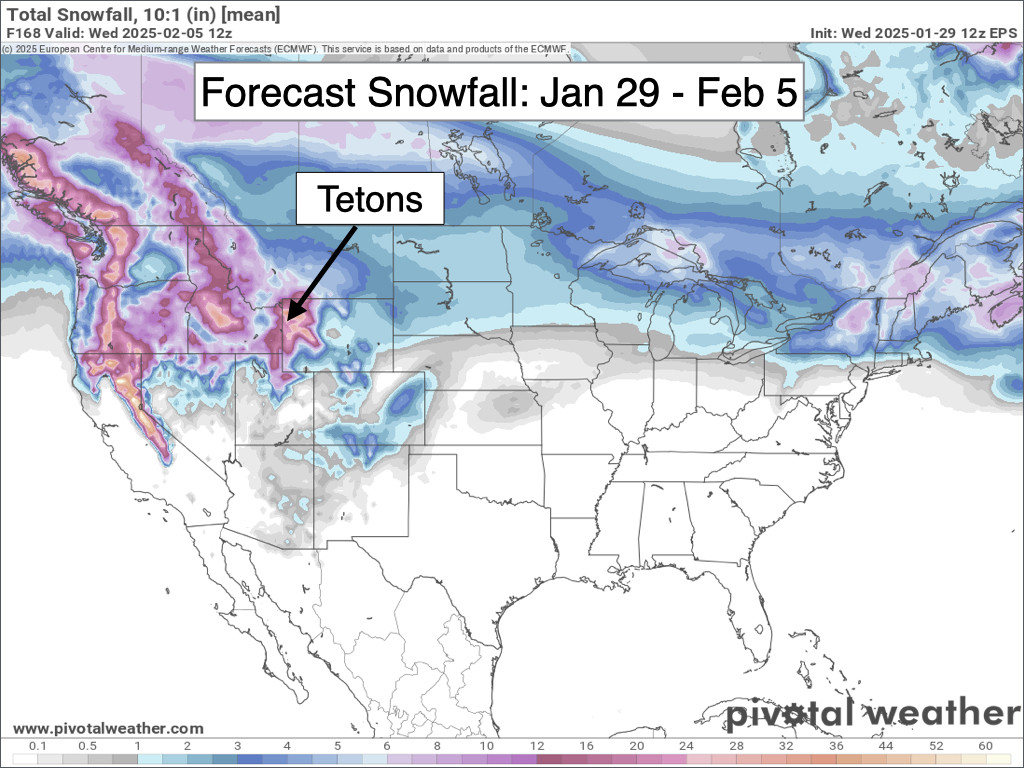
Looking further out, we should see colder temperatures arrive after February 5, with additional snow chances possible late next week through February 7 or 8.
Confidence in the pattern decreases significantly heading into mid-month, as is usually the case with 10+ day outlooks. Some models are projecting high pressure to return, while others are projecting a more active pattern to continue.
Alan Smith, Meteorologist