


JACKSON, Wyo. – Smoke has arrived in Jackson Hole from wildfires in Oregon, Idaho and Montana, where prevailing winds will be blowing from over the next week. Off-and-on periods of smoke are likely for the foreseeable future, with limited rain potential from isolated thunderstorms.
Fire and Smoke Updates
Hot and dry conditions this month have contributed to an uptick in wildfires across the Interior Northwest, especially over the past week. Temperatures have been well above average across this region in recent weeks, which has led to increased evaporation rates, allowing vegetation to dry out at an accelerated rate.
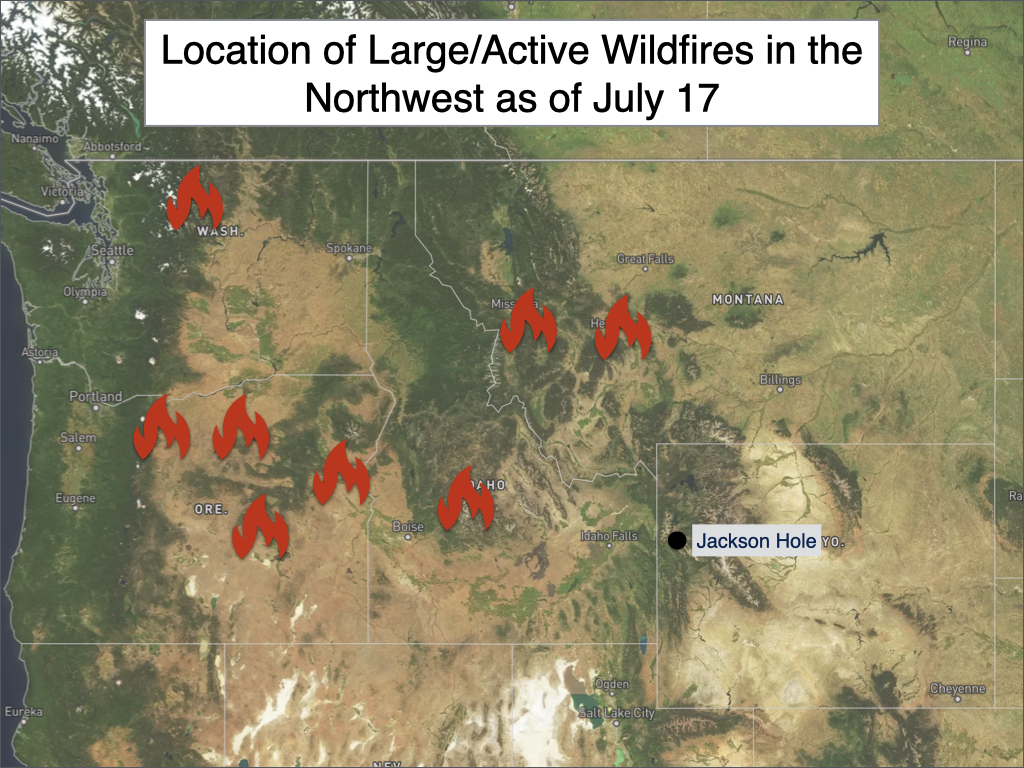
Large and active wildfires are currently burning in Central/Eastern Oregon, South Central Idaho (next to Redfish Lake in the Sawtooths), and Western Montana are producing smoke that has worked its way into Jackson Hole and Western Wyoming this week, leading to reduced visibility and air quality.

The map below shows the approximate location of the most notable active fires across the Northwest U.S. as of Wednesday, July 17.
On Thursday, we should see some temporary relief from the smoke as winds aloft (the direction the wind blows from) shift from west to southwest across Eastern Oregon where the largest fires are burning.
We may not clear out completely, but improvements in visibility and air quality are expected compared to prior days at least.
We may see a gradual uptick in smoke again from Friday through Sunday, and possibly beyond. Winds aloft will shift from west to northwest to north/northwest over time. At first, we could see some smoke arrive from the Bench Fire in Idaho (near Redfish Lake), followed by more smoke from Montana wildfires this weekend and early next week.
Keep in mind that day-to-day details in smoke transport are tough to nail down, because it is subject to small fluctuations in wind speeds and directions, and to fluctuations in fire behavior along with new fire starts.
We may not see any longer periods of smoke relief until winds shift to south or southwest, which is not expected for at least another week. And that also assumes there aren’t any new large fire events that start southwest of our area (including California), which is always a possibility later this summer.
Recent and Upcoming Weather Pattern
Last week, we saw four days in a row of 90+ degree temperatures in Jackson with a maximum temperature of 92ºF occurring on two different days. This week has been a little bit cooler so far as we’ve seen a weak intrusion of monsoonal moisture, which has resulted in more clouds and higher relative humidity.
Unfortunately, rainfall has been light and spotty across the region so far this week. On Sunday, a cluster of widespread thunderstorms moved across the Southern Tetons and Jackson Hole Valley, but measured rainfall amounts only ranged from a trace to 0.13 inches.
From Monday to Wednesday, we have seen very spotty and short-lived thunderstorms develop across the area, with most areas struggling to pick up more than a track of rainfall. A few locations in the Jackson Hole Valley north of town did pick up 0.1 to 0.2 inches of rain on Tuesday, however.
A similar pattern is expected for the remainder of this week with isolated thunderstorms on Thursday and Friday, but moisture levels will be even lower than prior days so only light and spotty rainfall is expected at best.
Temperatures will also trend warmer after a few days of highs in the low 80s. On Thursday and Friday, highs will top out in the upper 80s in the valley.
Over the weekend and into early next week, thunderstorm chances will be more marginal. While some isolated activity couldn’t be ruled out at times, the overall potential looks lower compared to prior days. High temperatures are expected to top out in the upper 80s to near 90 this weekend and early next week.
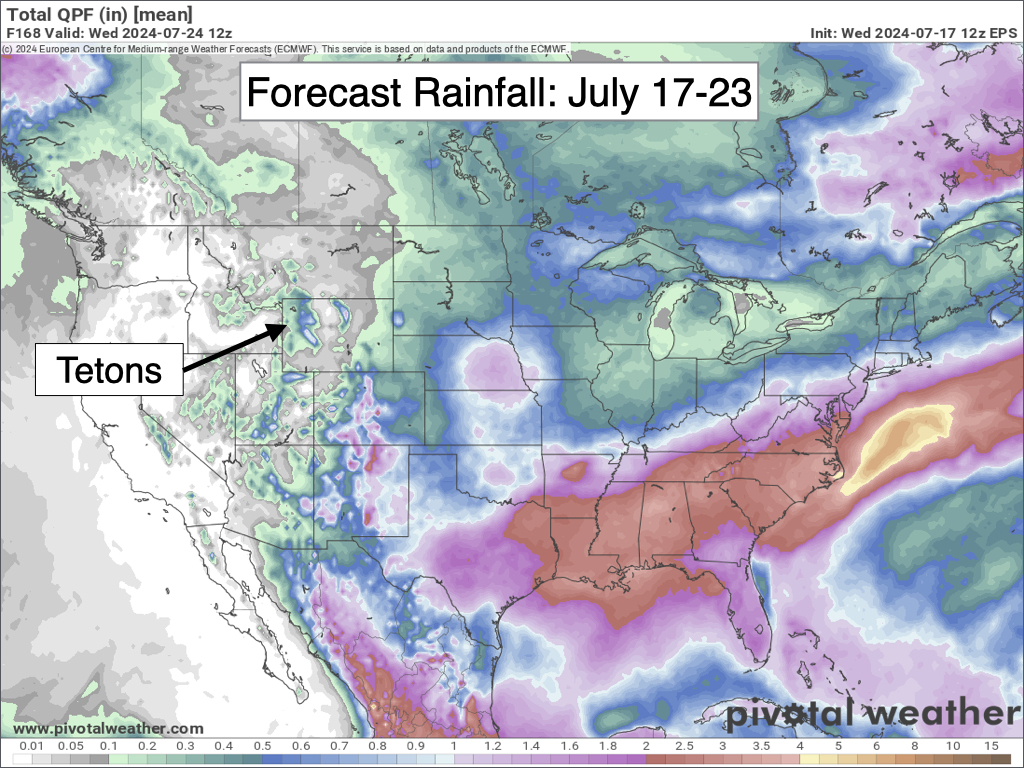
Here is a seven-day rainfall projection from the average of multiple simulations of the European weather model. One thing to note from this map is that rain and thunderstorm chances will be higher over the Wind River Range and other areas along and east of the Continental Divide, though thunderstorm rainfall will still be spotty in nature.
July Weather So Far
While the Far Western U.S. has been much hotter than average so far this July, believe it or not, temperatures in Jackson for the month of July are right around average halfway through the month. This is because the first eight days of the month were cooler than average before we really heated up last week.
There is a high likelihood that we will finish the month with above-average temperatures, however, given the outlook over the next couple of weeks.
Rainfall has been paltry this month across the region. So far, Jackson has only received 0.13 inches of rain in July and Driggs has only received 0.22 inches of rain.
While July is the driest month of the year on average, we are still likely to finish well below Jackson’s monthly rainfall average of 0.82 inches barring any major changes to the weather pattern or stray heavy thunderstorms late in the month.
Fire Danger
Last week, fire danger was raised to “High” across the area by the Teton Interagency Fire Center as well as Yellowstone National Park.
While vegetation fuels are already primed to burn, cooler temperatures, higher relative humidity values, and lighter winds early this week did help to temper fire danger somewhat.
However, fire danger will begin to creep back up again late this week due to rising temperatures, decreased moisture, and a potential for “dry” thunderstorms – meaning storms that produce lightning but very little rainfall.
Around the middle to latter part of next week, longer-range models are projecting a trough of low pressure to move across the Pacific Northwest and Northern Rockies, passing just north of our area.
While this trough could potentially draw in enough moisture northward for an uptick in thunderstorm chances, it also has the potential to lead to a period of hot, dry and windy conditions prior to any moisture surges. This will be something to keep an eye on next week.
Alan Smith, Meteorologist










