YELLOWSTONE NATIONAL PARK — For more than 50 years, geologists have categorized the rock left behind in Yellowstone National Park’s (YNP) last super eruption 631,000 years ago into two geologic layers. One Caldera Chronicles suggests that line might never have existed.
The new study focuses on Lava Creek Tuff is the deposit left behind from that super eruption. It’s a result of the eruption that ejected more than 240 cubic miles of material.
Stacy Henderson, a Ph.D. candidate at Montana State University, writes this week’s piece.
Since geologists first mapped the deposit in the 1960s, they’ve split it into two units: member A and member B. The main difference was a mineral called amphibole, which showed up in member A rocks but not member B. This distinction shaped how scientists understood what was happening underground before the blast.
Recently, however, researchers began finding Lava Creek Tuff deposits that didn’t fit either category. Rocks in the park’s Sour Creek dome, which is thought to belong to the 2.1-million-year-old Huckleberry Ridge Tuff, turned out to be from the Lava Creek eruption, and many of them didn’t match member A or B.
“If some Lava Creek Tuff deposits cannot be classified as either member, is the two-member model still the best way to divide Yellowstone’s most recent supereruption?” Henderson writes.
Researchers examined more than 100 rock samples under the microscope and found only 13 amphibole crystals, mostly near Madison Junction. Three of those came from deposits mapped as member B. And about half were found in a small deposit along the Gibbon River that turned out to be 140,000 years older than the Lava Creek eruption itself, meaning one of the key examples used to define member A isn’t part of the Lava Creek Tuff at all.
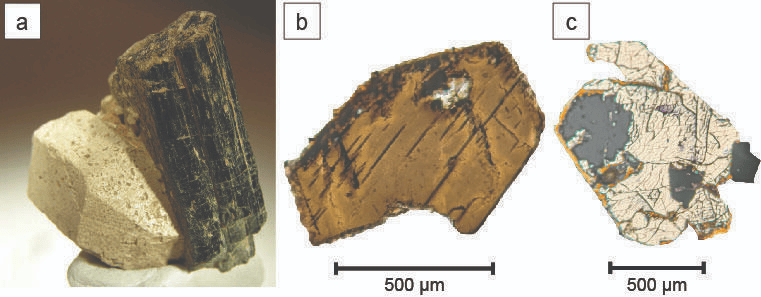
The team also measured another mineral with crystals that carry a chemical fingerprint of the magma they formed in. If the two members came from different sources, their crystals should look chemically different. Instead, the same barium signatures showed up in both.
Every method the researchers tried failed to find a clean split between the two members. Instead the deposit appears to record a more complex eruption. Going forward, Henderson writes, scientists will need to redraw the lines on the map and revisit earlier interpretations of the eruption and the magma behind it.