JACKSON, Wyo. – Big changes are coming to the Tetons this week. Following weeks of dry weather and 70-degree temperatures, a Pacific storm system accompanied by a strong cold front will bring accumulating snow down to 7,000 feet on Thursday with flakes possible in the valleys on Thursday night.
Recent Warm and Dry Weather
We are nearing the end of a remarkable dry spell that has lasted for nearly a month. Today marks day number 27 without precipitation in Teton County, which based on data for the town of Jackson, makes this the longest dry spell in the past 15 years.
Jackson’s Longest Dry Spells in the Past 15 Years:
- 27 Days – September-October 2024
- 25 Days – September 2018
- 24 Days – August 2020
- 23 Days – October 2022
- 22 Days – August 2013
- 21 Days – August 2019
- 20 Days – July 2020
- 20 Days – August 2012
- 19 Days – June-July 2016
- 19 Days – September-October 2012
The Pack Trail Fire has become very active during this warm and dry spell, and smoke from this fire has resulted in periods of “Unhealthy” to “Hazardous” air quality at times in the Jackson Hole Valley.
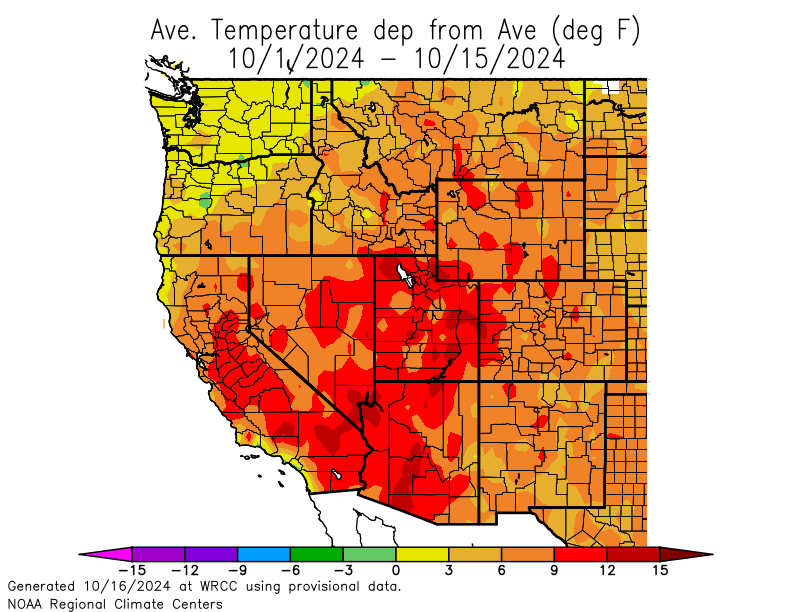
Temperatures are running 4.5ºF above normal in Jackson so far in October. However, that is if you factor in high and low temperatures.
Average high temperatures in Jackson are running 12.2ºF above normal so far this month. The 15-year average high for October 1-16 is 61.0ºF, but this year, the average high for the first 16 days of the month is 73.3ºF. In fact, we have hit 70ºF on all but two days so far this month.
Low temperatures have actually been 3.3ºF below average so far this month. This is indicative of the dry airmass, resulting in warm days and chilly nights with huge temperature swings between high and low temperatures.
For the Western U.S. as a whole, October has been remarkably warm so far. But changes are heading our way later this week…
Upcoming Weather Pattern
A Pacific storm system will arrive on Thursday, signaling the end of our dry spell with balmy temperatures. If you’re hoping to enjoy dry trails and 70-degree temperatures one last time (if you can escape the smoke), Wednesday afternoon is your chance.
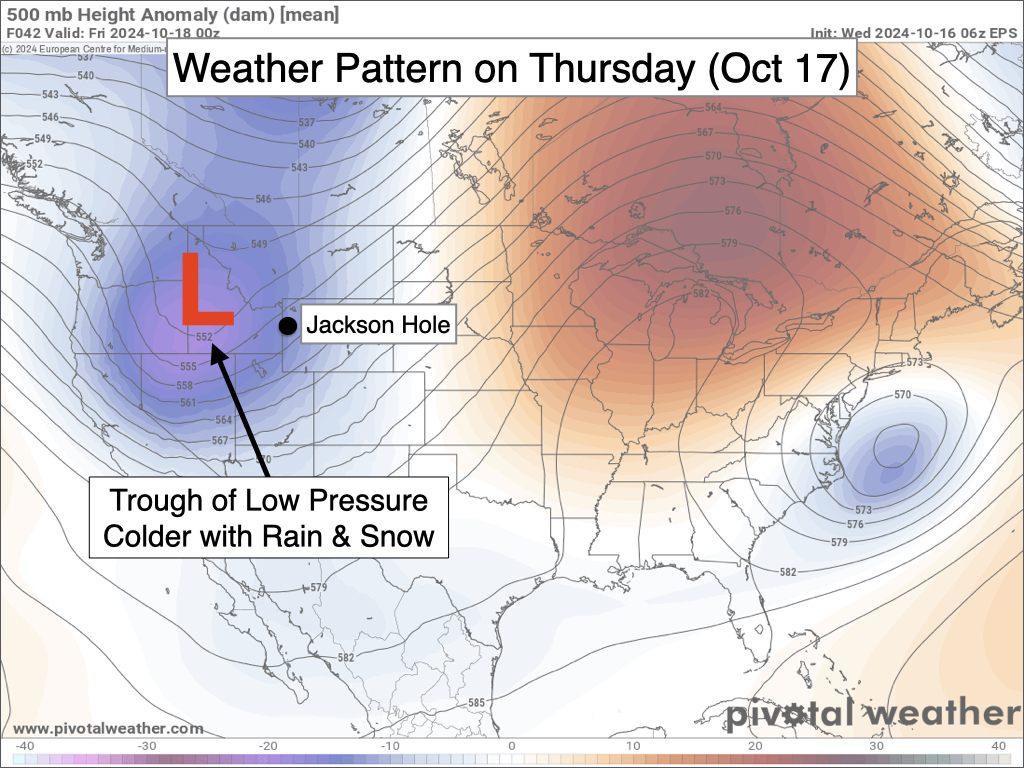
Increasing winds out of the southwest ahead of the storm should actually help to push the smoke out of the Jackson Hole Valley earlier in the afternoon compared to prior days. On the flip side, the gusty winds could fuel active fire behavior east of Jackson Hole for one more day.
Thursday’s storm will come in two main waves, and a cold front will be arriving with each wave.
The first wave will arrive after midnight on Wednesday night with rain and snow developing late in the night and continuing through about mid-morning Thursday. Snow levels will start out as high as 9,000-10,000 feet initially before dipping to around 8,000 feet by sunrise on Thursday morning.
Snow will likely be falling at the top of Teton Pass during the morning commute on Thursday, but whether or not snow accumulates on the road will largely depend on the rate of snowfall (heavier snowfall rates are needed for accumulations when the road surface is warm and air temperatures are borderline).
A lull in the action is expected from about mid-morning to early afternoon on Thursday, then the second wave will bring rain and snow from mid-afternoon to early evening.
Snow levels will be lower with this second wave, ranging from 7,000-7,500 feet, and winter road conditions are expected over Teton Pass during the evening commute with slushy roads and limited visibility possible at times.
On Thursday evening, a cold front will arrive at the end of this system, and snow levels will likely dip to the valley floor just as precipitation is winding down. So the town of Jackson and lower valleys could see some flakes, but little to no accumulation is expected below 6,500 feet.
Lingering flurries are possible on Thursday night and Friday morning, but the wind direction will be unfavorable for anything of significance by this point. More widespread snow is expected from Togwotee Pass eastward on Friday, however, including much of Central Wyoming.
Road conditions are likely to be icy over Teton Pass on Friday morning with colder air in place, so extra caution is advised if driving over the pass. Especially since this is the first storm of the season, and many cars don’t have winter tires on yet.
Areas above 8,000 feet in the Tetons will pick up 2-6 inches of wet snow from this storm, and Togwotee Pass should see similar amounts, which will help to significantly reduce fire activity.
Below is a weather model projection for total snowfall across the region. This model assumes a 10 to 1 snow-liquid ratio, whereas snow-liquid ratios will probably be closer to 8:1 given the wet nature of the snowfall.
In other words, this map of snowfall totals is probably a little bit overdone, but still gives a good general idea of what to expect regionally.
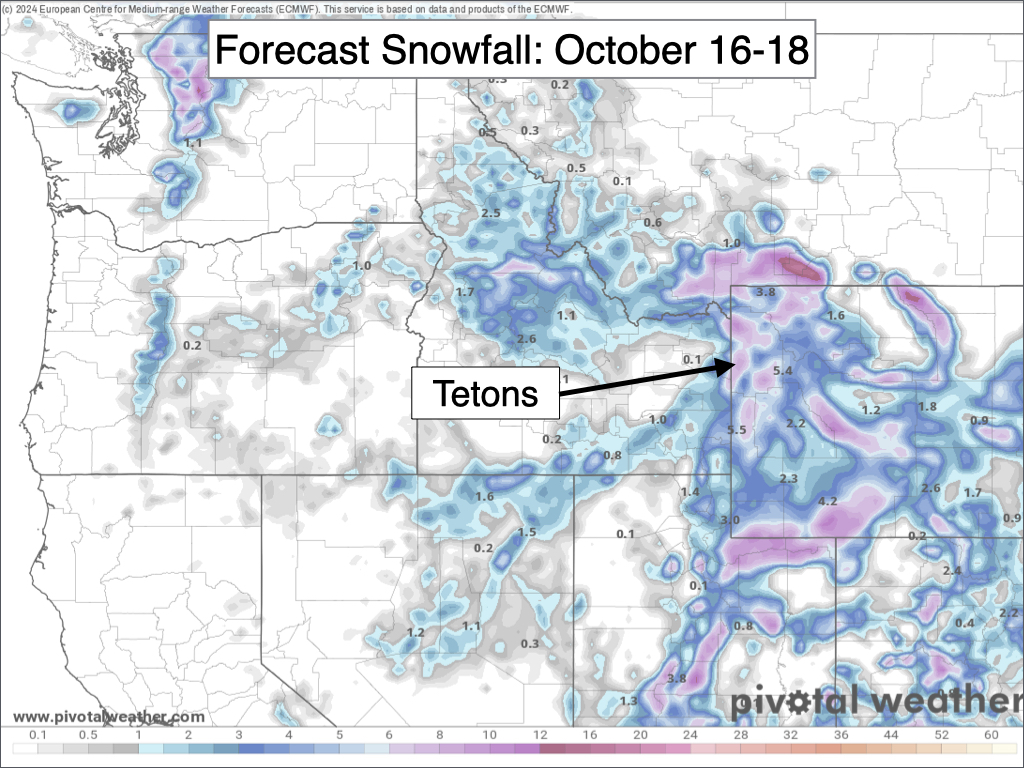
The towns of Jackson, Driggs, Victor, and Alpine will see a cold rain for most of this event before the potential changeover to light snow at the very end.
Highs in the valleys will be in the 40s on Thursday and Friday, which will be a big change from the 70s we’ve become accustomed to.
Dry conditions are expected to return this weekend with highs in the 50s, which is close to seasonal levels for this time of year.
Next week, confidence in the pattern decreases. We will be on the southern fringe of the favored storm track, so we could see some occasional shower chances sneak into the area.
No major storms are anticipated at the moment (at least through mid to late next week) and temperatures will also be near seasonal levels with highs in the 50s most days, perhaps trending a little warmer or cooler on any given day depending on cloud cover and precipitation.
Alan Smith, Meteorologist