


JACKSON, Wyo. – September 2026 featured near-average temperatures and rainfall across the Jackson Hole area, while October is expected to be warmer and drier than average.
Recent Weather Pattern
Over the past week, beautiful fall weather has largely prevailed with highs ranging from the upper 60s to mid 70s on most days under abundant afternoon sunshine.
The one exception was a weak system that moved through on Sunday night and Monday, which produced rain showers along with some isolated lightning activity. Temperatures were also cooler with highs in the low 60s in Jackson.
The town of Jackson only received 0.15 inches of rain from this disturbance, but rain totals were heavier in the mountains, ranging from 0.4 to 0.9 inches above 8,000 feet.
Snow levels appear to have dipped as low as 10,500 to 11,000 feet on Monday morning, but we still have not seen any colder fall storm systems yet with snow accumulating down to ski resort elevations.
Here is the 7-day weather summary for the town of Jackson:
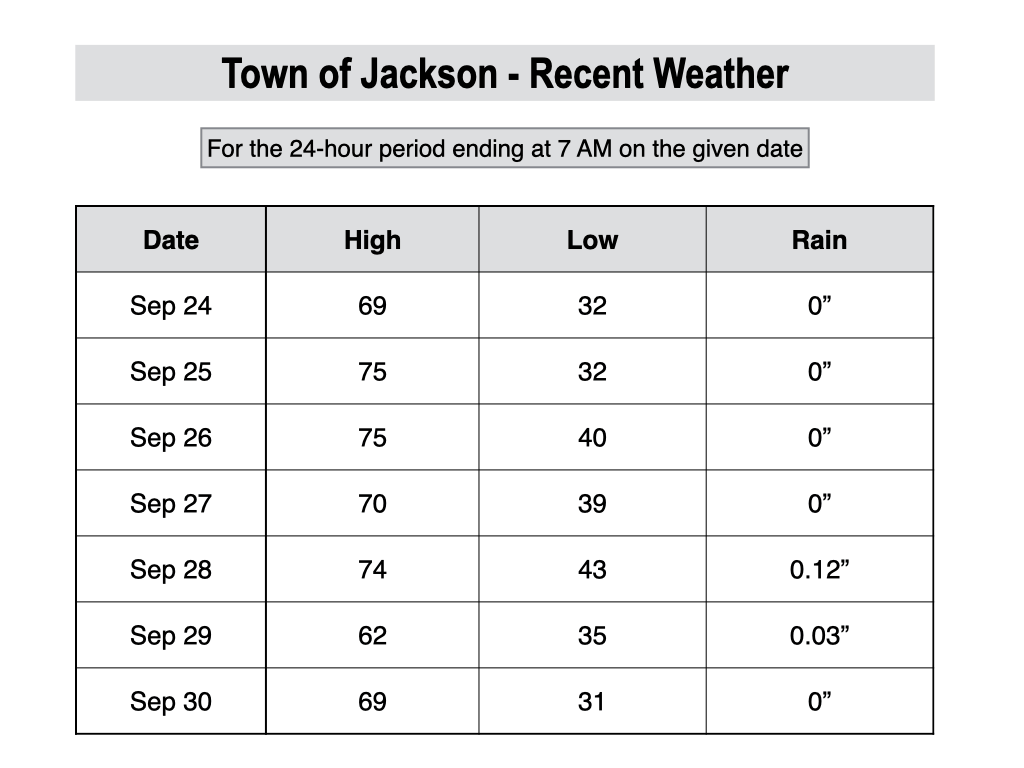
For perspective, the average high and low temperatures in Jackson on September 30 are 67º and 31º.
September 2026 Review
In some ways, September was the most “normal” month we have seen all year as temperatures and precipitation ended up right around average.
However, there were some local variations with the town of Jackson running just a touch below average for precipitation while the Teton Range and Teton Valley were above average for precipitation.
We were right on the edge of the dominant storm tracks for most of the month, with stronger systems early in the month bringing heavy rain to parts of the Inland Northwest, while a late season monsoon fueled by an active hurricane season in the Eastern Pacific brought abundant rain to the Southwest with Jackson catching the edge of this activity at times.

The wettest period during the month was a system that tapped into this subtropical moisture from the south from September 17-19, when 1-3 inches of rain fell across Teton County.
For the rest of the month, rainfall was more sporadic with several weaker disturbances bringing scattered showers and thunderstorms.
Temperatures ended up just slightly above average for the month, with no major extremes on either end.
Zooming out across the Western U.S., in terms of temperature we were also right in between with cooler anomalies across the West Coast, and warmer anomalies near/east of the Continental Divide and across the Southwest.

The average high temperature for the month of September in Jackson was 71.0º, which is 1.8º below the 2010-2025 average, while the average low was 37.8º, which is 3.0º above the 2010-2025 average.
When factoring in the average highs and lows, temperatures for the month were 0.6º above the 2010-2025 average.
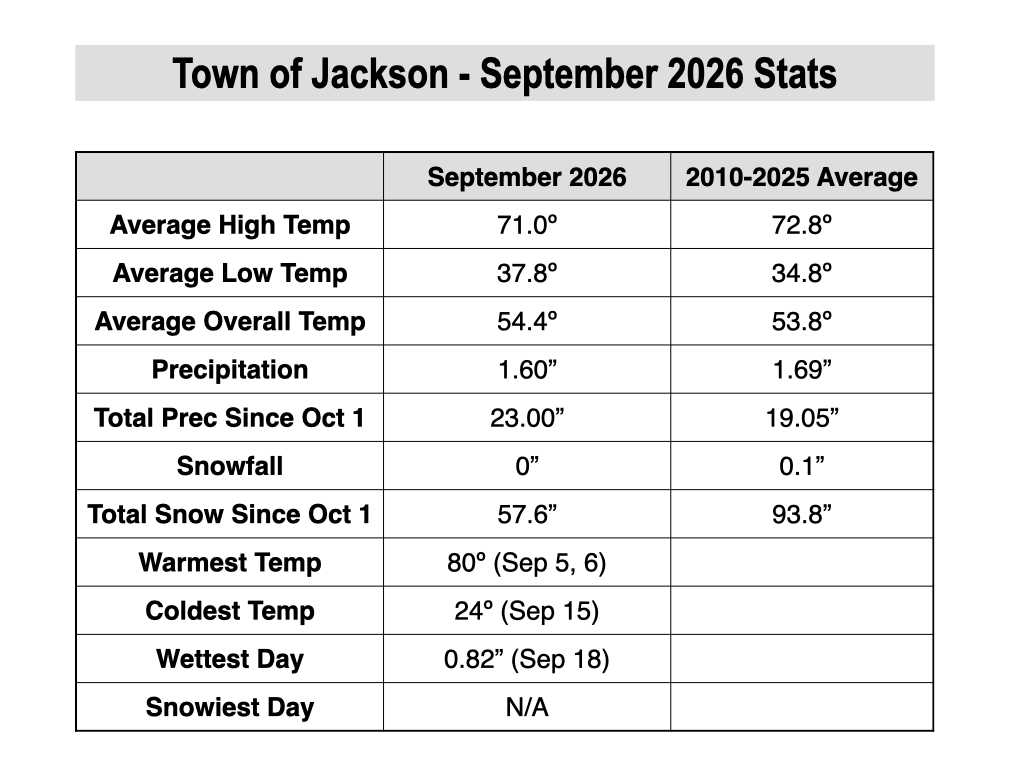
In the town of Jackson, rainfall was very close to average with 1.60 inches recorded for the month, compared to the 2010-2025 average of 1.69 inches.
Rainfall in the mountains was more impressive in September, as all four weather stations that measure precipitation at Jackson Hole Mountain Resort received over 4 inches of rain during the month, and Targhee also recorded 4 inches of rain.
Despite having near-average temperatures for the month as a whole, snow levels remained high throughout the month, generally staying above 11,000 feet. Typically in September, we see snow accumulate down to 9,000-10,000 feet (if not lower) at least once.
Water Year 2026 Recap
September 30 is also a milestone date for climatology in the Western U.S. as this is the final day of the “water year”, which is a more appropriate measure for annual statistics in Western locations since it factors in the entire winter snowpack (rather than starting in the middle of the winter on January 1).
For the water year as a whole dating back to October 1, 2025, it was exceptionally warm across our area with overall temperatures in Jackson running 4.6 degrees above normal. This is an impressive deviation from average for an entire 12-month period.
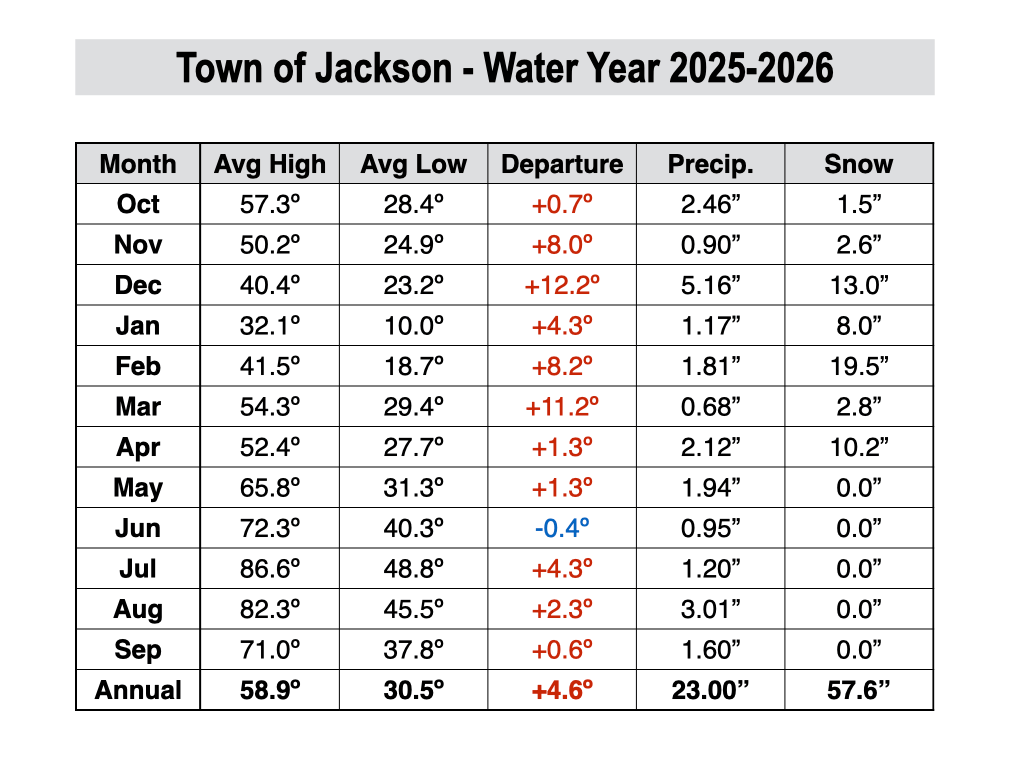
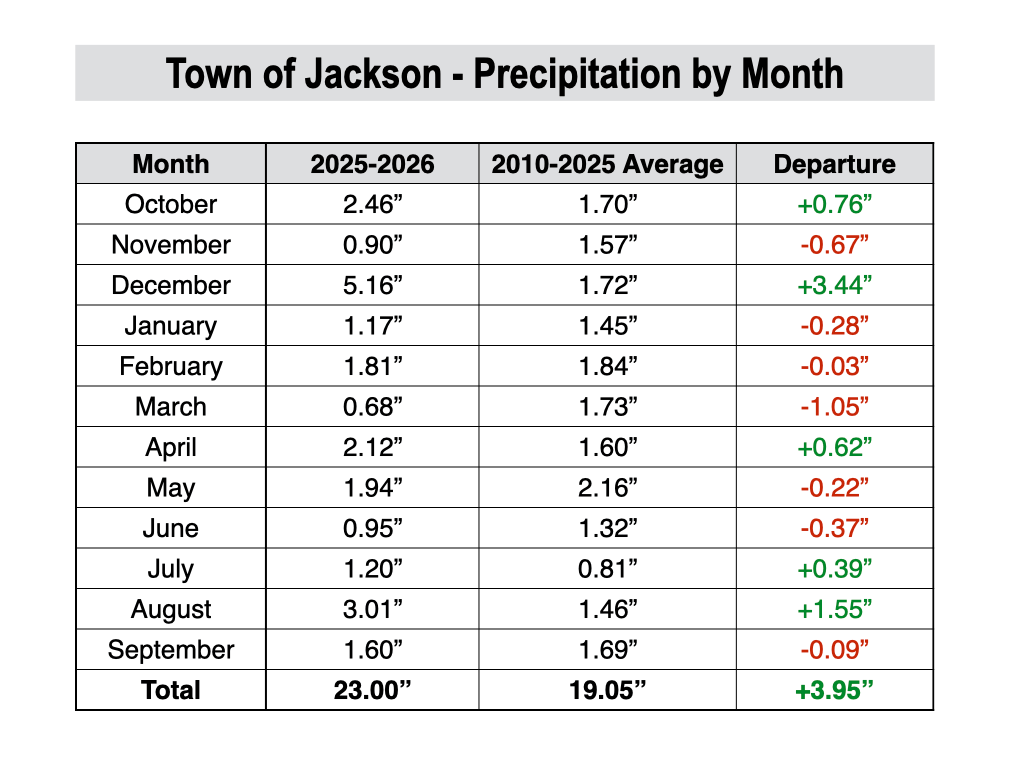
However, precipitation in the town of Jackson ended up well above-average for the water year despite the warmth, though snowfall was well below average.
Here is the monthly breakdown of precipitation relative to average in the town of Jackson.
For the Teton Range as a whole, precipitation was right around average for the water year, though possibly a bit above average at Jackson Hole Mountain Resort (this is tough to say for sure, as long term annual precipitation data is lacking at JHMR).
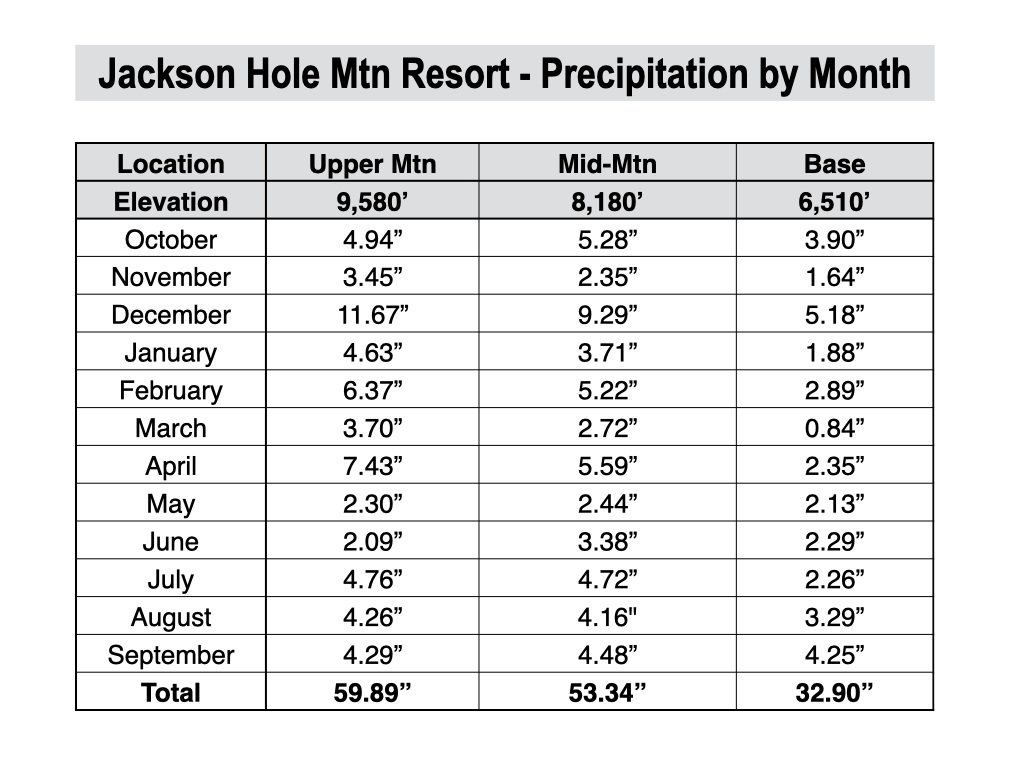
Here is the monthly breakdown in precipitation for the upper mountain (Rendezvous Bowl), mid-mountain, and base area at Jackson Hole Mountain Resort. The upper mountain nearly hit 60 inches for the water year, with July, August, and September all exceeding 4 inches.
Upcoming Weather Pattern
October will begin with beautiful fall weather as a ridge of high pressure builds over the Western U.S.
This will result in mild and dry conditions along with abundant sunshine. Highs will reach the low to mid 70s in the valley most days, while overnight lows will dip to near freezing on most days.
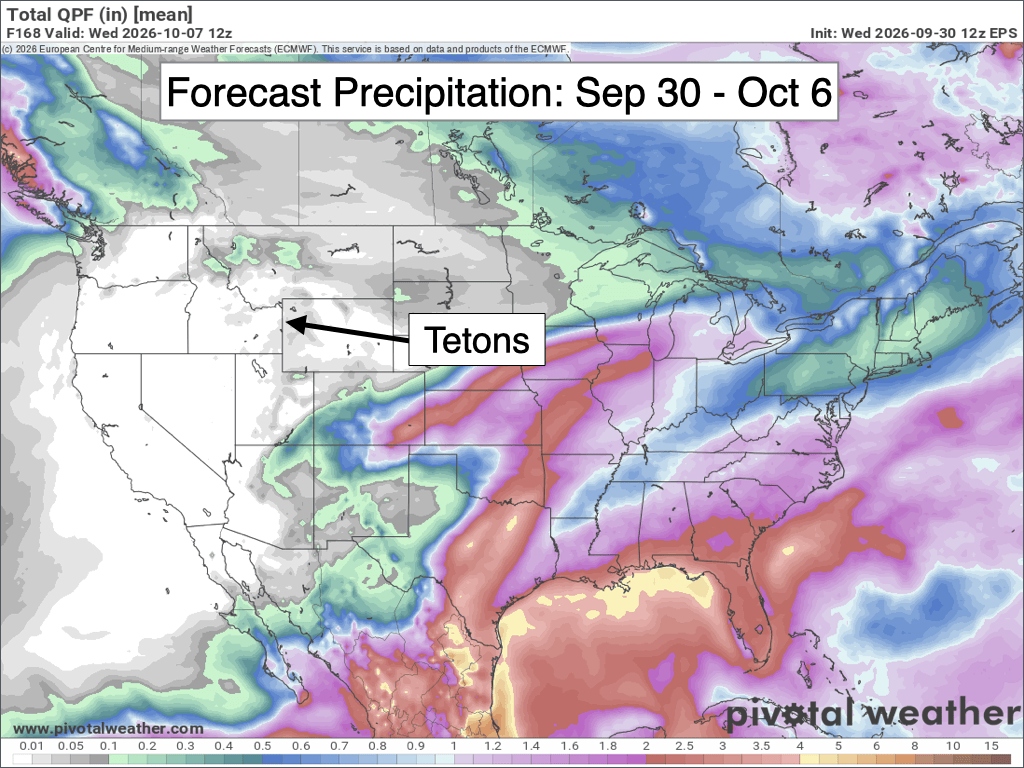
The 7-day precipitation projection below below represents the average of 50 simulations of the European Model. The vast majority of these model runs project zero precipitation in our area over the next week, with only a few projecting light preciptiation.
In other words, it’s unlikely we will see any precipitation for at least the next week.
October Outlook
Climatologically speaking, October features the largest change in average temperature from the beginning to the end of the month compared to any other month.
This is an indication that the first winter-like spells can often hit fast in the Tetons at this time of year, even if more sustained cold and snow hold off until later in the year.
Weather conditions can vary widely in October, ranging from warm and sunny to cool and wet to cold and snowy.
Valley temperatures in the 70s are not uncommon early in the month, while at the same time, low temperatures in the teens are also not uncommon, and even single digits are not unheard of late in the month.
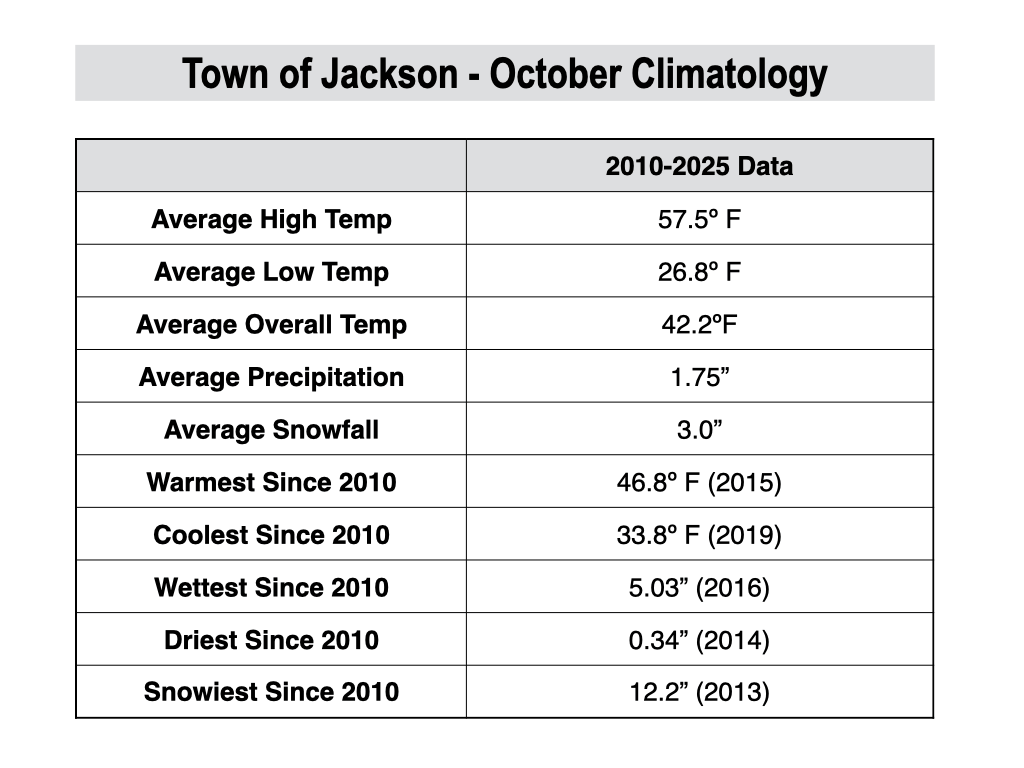
For the month as a whole, the average high in Jackson during October is 57.5º while the average low is 26.8º.
At the beginning of the month, average highs are in the mid 60s with average lows in the low 30s, but by the end of the month, average highs are only in the upper 40s with average lows in the low 20s.
Average precipitation in the town of Jackson is 1.75 inches in October, but amounts can vary substantially from year to year. For example, in October 2014, Jackson only received 0.34 inches of precipitation, but in October 2016, Jackson received 5.03 inches of precipitation.
The town of Jackson typically receives its first accumulating snowfall during October, with an average first snow date of October 16. However, snowfall in town is typically light and short-lived in October with an average monthly snowfall of 3 inches.
In recent years, October snowfall in town has been particularly lean. The last time we received more than 6 inches of cumulative snowfall in town during October was in 2020 when 6.5 inches fell.
In the Tetons, average snowfall in October is 29 inches at Jackson Hole’s Rendezvous Bowl Plot and 17 inches at Jackson Hole’s Mid-Mountain Plot. The snowiest October on record for the Rendezvous Bowl Plot is 54 inches, which occurred in both 2009 and 2016.
For October of 2026, confidence is fairly high that conditions will be warmer and drier than average as models are in good agreement with a strong ridge of high pressure setting up over the Western U.S. for at least the first half of the month.
Longer-range models have also been trending toward a high pressure dominant pattern potentially prevailing into late October, though odds are, we will probably see a storm system sneak in at some point if the overall pattern favors drier conditions.
Even so, it looks like winter is going to hold of for a while, even in the mountains, with dry trails expected to prevail for at least a couple more weeks.
Despite last year’s bummer of a winter, skiers and riders shouldn’t be concerned about the dry October outlooks, as October weather and snow conditions have no bearing on what to expect for the winter ahead (there have been plenty of good winters that occurred after dry Octobers).
Alan Smith, Meteorologist










