JACKSON, Wyo. — Over the last two decades, there has been a growing body of evidence indicating that two of our community’s most cherished resources, Fish Creek and Flat Creek, are suffering from the impacts of human activity. Previous studies and experiential evidence indicate that excess sediment, nutrients and bacteria are degrading their water quality. Both creeks have been listed as impaired for E. coli by the Wyoming Department of Environmental Quality (DEQ) since 2020. These impairments persist based on samples collected in 2017. How can six-year-old data be used to guide the proper management of these streams? Have we really gotten closer to addressing the sources of pollution within our control?
The 2022 Teton County Septic System Effluent Monitoring Study, the first of its kind conducted in our unique high-altitude gravel-bed river floodplain environment, confirmed that our valley’s cold climate and porous soils induce deficient year-round septic tank and leach field performance. Furthermore, a 2022 University of Wyoming study on Fish and Flat Creek found that human wastewater was the dominant identifiable source of fecal bacteria in each stream, suggesting that groundwater may be transporting potentially harmful bacteria to the creeks we love to float, fish and swim in.
These questions, coupled with these recent studies’ conclusions, lead Protect Our Water Jackson Hole (POWJH) to launch a new monitoring program to further examine water quality across our watershed.
This program is designed to protect human health and improve management decisions. One key component of this program, developed in collaboration with private, nonprofit and local government partners, is collecting E. coli and microbial source tracking samples on Fish Creek and Flat Creek. These samples show the overall levels of E. coli and identify the sources, whether from animals or human wastewater.
The process begins with Alder Environmental staff collecting samples from five points along both Fish Creek and Flat Creek. These samples are collected from May through September. Next, this data is shared with health and management agencies: our local health agency, Teton County Public Health (TCPH), and state agencies, DEQ and the Wyoming Department of Health (WDH). These agencies now have access to the data necessary for making informed management decisions and letting the public know about health risks during the peak recreation seasons.
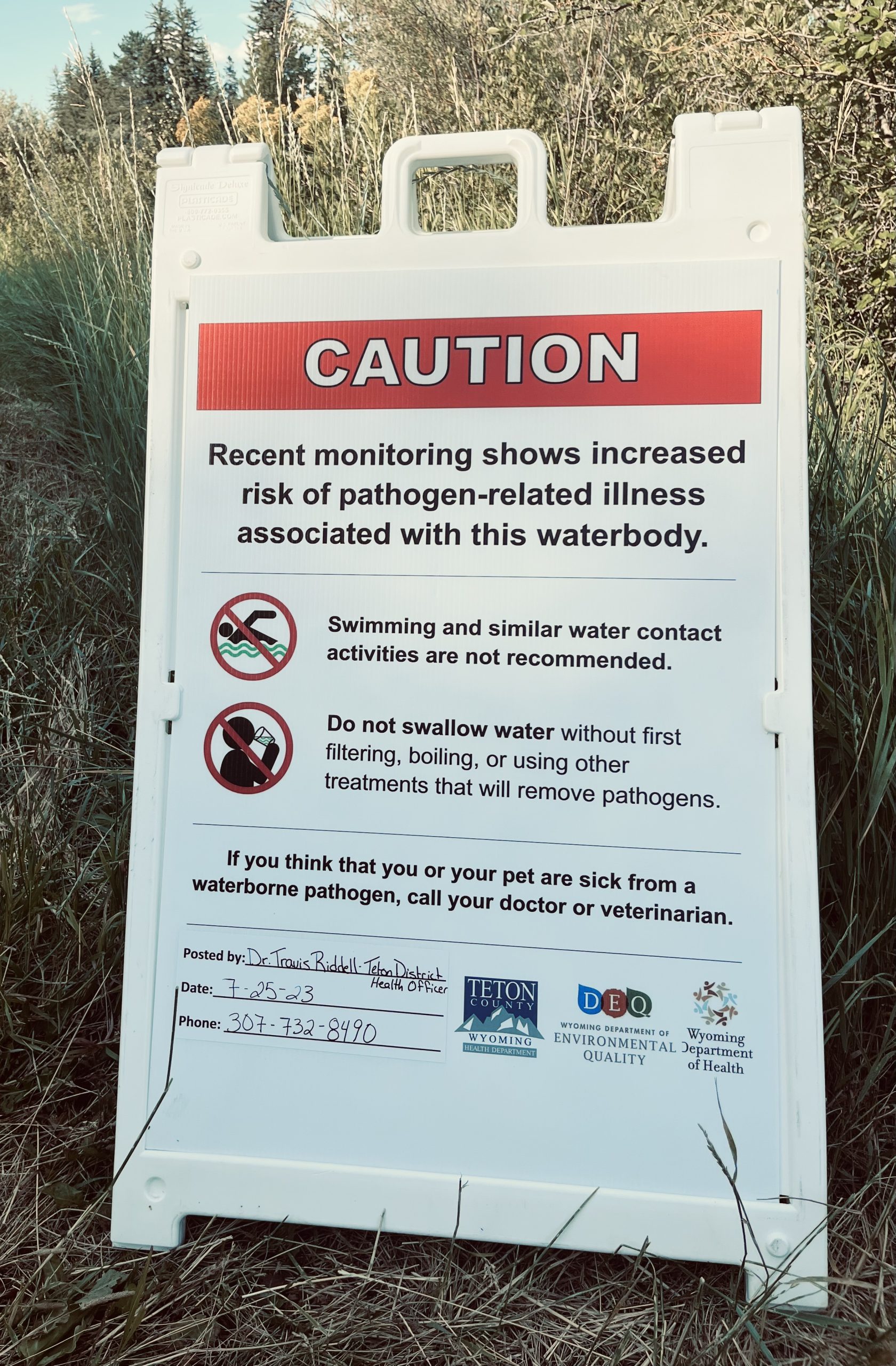
Maybe you’ve seen a CAUTION sign near Hunt Bridge on Fish Creek over the last few weeks, or received the alert from Teton County about the sign? Perhaps you’ve been past this site in the last few days and noticed the CAUTION sign is no longer there?
Instead, you will find an AWARENESS sign containing general information about the risk of exposure to fecal bacteria and other waterborne pathogens while recreating in surface water. AWARENESS signs were also posted by TCPH staff at Russ Garaman Park, at Karns Meadow, and at the bridge over Flat Creek in Rafter J.
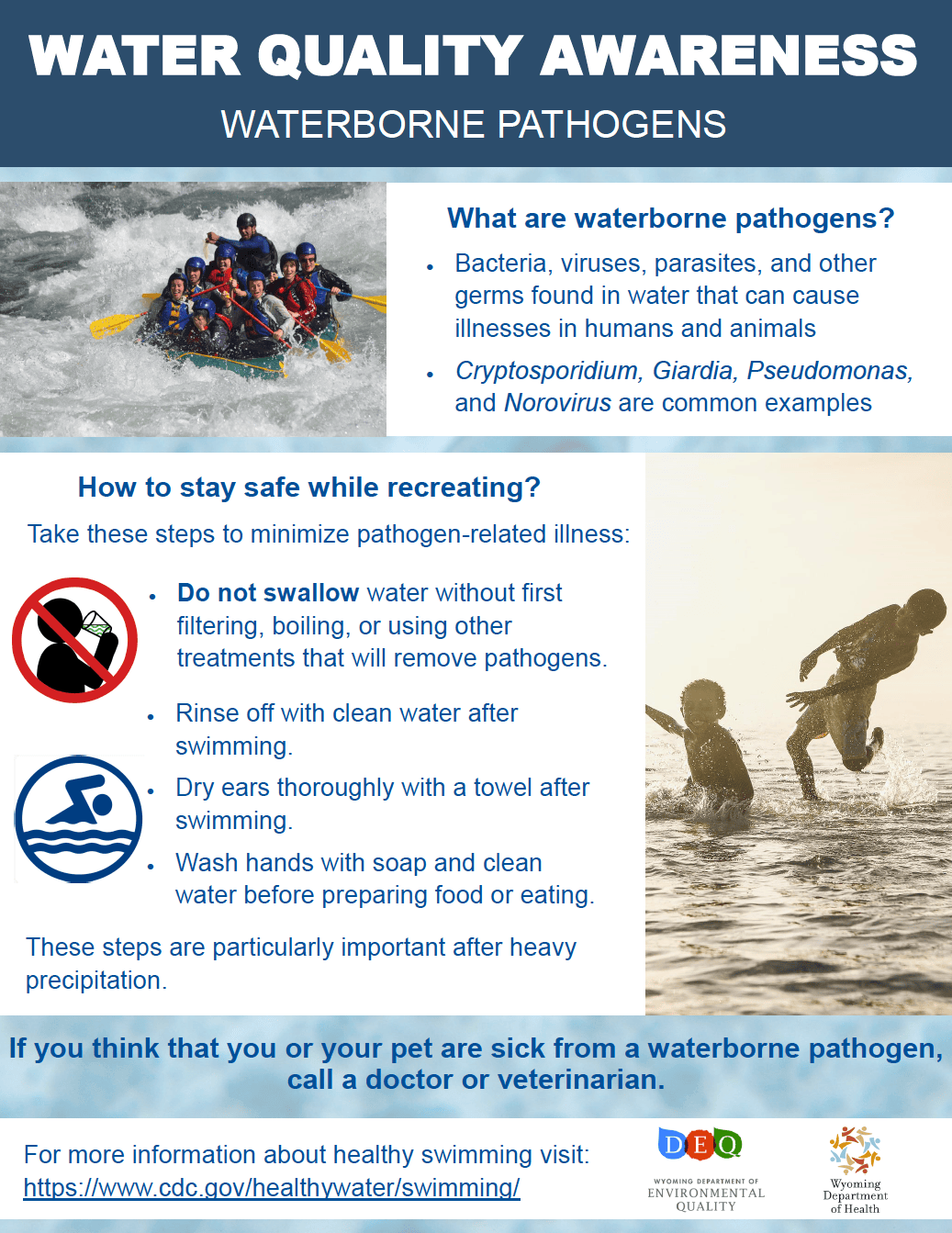
The process for posting a CAUTION or AWARENESS sign in Teton County works like this. Certain public access sites are monitored at least every two weeks during the peak recreation season to determine if E. coli concentrations exceed key thresholds (i.e. 235 organisms per 100 milliliters). Next, the data is validated by agency experts at the local level (i.e. TCD) and state level (i.e. DEQ and WDH). WDH will then give the Teton County District Health Officer the green light to post the CAUTION sign. That is what happened on July 28th. That CAUTION sign must remain in place until two independent sampling events produce data below the key E. coli threshold. Samples from August 2nd and August 16 led to the downgrading from the CAUTION sign to the AWARENESS sign.
There are many factors that can affect potential exposure to a waterborne pathogen. In addition to the information presented on the AWARENESS sign, it is important to understand that recent heavy rainfall sends runoff carrying animal waste, sediment and other contaminants into our rivers and creeks. As a result, it is best to avoid swimming after these events.
In addition to the monitoring on Fish Creek and Flat Creek, there is also a monitoring program on Snake River through a partnership with the U.S. Geological Survey. The data collected this year will help focus future monitoring and management decisions. The information collected not only informs better use of these waterways, but also improves our understanding of the issues plaguing them. These efforts are targeted at restoring and protecting these irreplaceable community resources.
While POWJH and its supporters are the major funders for monitoring on Fish Creek and Flat Creek, this program would not be possible without the generous support of project partners. These partners include Teton County, the Town of Jackson, TCD, Jackson Hole Trout Unlimited, a private charitable foundation and the Community Foundation of Jackson Hole’s Youth Philanthropy Program.
To learn more about this water quality monitoring program, please join us at our next free Tap Into Science presentation at Snake River Brewing on Monday, Sept. 11, at 5:30 p.m. You can make an impact on local water quality during the Old Bill’s Giving Season by supporting Protect Our Water Jackson Hole. Your gift can help POWJH protect and restore the surface water and groundwater of Teton County for current and future generations. Give via Old Bill’s today! To learn more visit powjh.org.