JACKSON HOLE, WYO – Life as we know it on Planet Earth requires oxygen. Earth’s atmosphere is abundantly oxygenated but that wasn’t always the case. When did the ‘oxygen boost’ occur and what caused it? Critical questions for understanding most all life as we know it today.
A special presentation hosted by Geologists of Jackson Hole entitled “Oxygenation of Earth’s Atmosphere: Rotation and Day Dependent?” will be presented by Gregory Dick, a professor at University of Michigan.
Dick will explore the link between increasing length of days and the role photosynthesis plays in creating oxygen as a major reason why earth ‘suddenly’ came to life after toward the close of the Precambrian period.
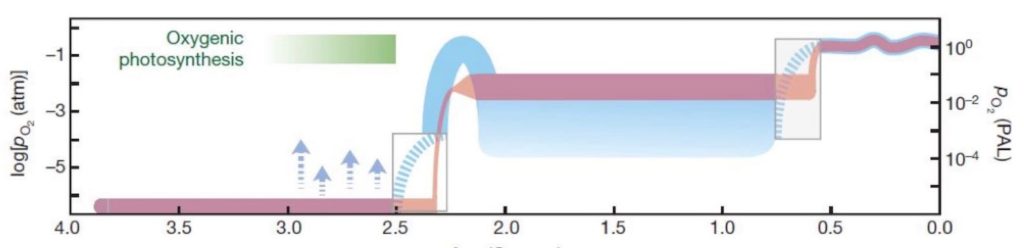
For the majority of Earth’s history there was not enough O2to support animal life. In fact, some three billion years ago the Earth’s atmosphere was virtually devoid of oxygen entirely.
But earth’s rate of rotation began increasing—eventually enough to give us our current 24-hour days—and at a point in time about 2.4 billion years ago, oxygen was released from the seas as a byproduct of photosynthesis by cyanobacteria.
How much so? About two billion years ago, oxygen is estimated to have made up about 1% of the atmosphere. By 800 million years ago, our atmosphere contained about 21% O2. The increase helped form simple marine plants, which, in turn, breathed life into more complex organisms.

In addition to depending oxygen, life also played a crucial role in producing oxygen. O2-producing photosynthesis is the only known source of O2 sufficient to fill our atmosphere. Despite this importance of biology in Earth’s oxygenation, comparatively little work has been done to understand biological controls or constraints on oxygenation.
The presentation will explore how the biology of cyanobacterial mats—thought to be key producers of O2in deep geological time—may help explain why O2levels remained so low for so long.
Our studies of modern cyanobacterial mats suggest that the intensity and duration of light, coupled with unexpected microbial behaviors, are critical, yet heretofore overlooked factors in determining how much O2 is produced.
The finding is intriguing in the context of how day length has varied through geological time. Results modeling the effect of day length on O2production in cyanobacterial mats indicate that it could help explain the pattern of Earth’s oxygenation. Thus, we suggest that changes in earth’s rotation rate, together with biological behaviors and feedbacks, conspired to give us the O2-rich atmosphere we enjoy today.
Geologists of Jackson Hole presentation of “Oxygenation of Earth’s Atmosphere: Rotation and Day Dependent?” featuring Dr. Gregory Dick will take place at the Teton County Library Auditorium on Tuesday, July 3 at 6pm.