JACKSON, Wyo. – An active weather pattern during late December and early January resulted in heavy snowfall in the Tetons, and snowpack is right at average now following a slow start to the season. Another storm will arrive this weekend followed by a dry spell next week.
December 2024 Review
The first half of December was very quiet across our area and snowpack was near record low levels by mid-month.
However, a substantial pattern change occurred during the second half of the month with two major multi-day storm cycles occurring December 14-18 and December 26-31.
Snowfall for the month ended up right around average with 91 inches of snow recorded at Jackson Hole’s Rendezvous Bowl Plot (9,580 feet), 74 inches recorded at Jackson Hole’s mid-mountain (8,180 feet), and 22.5 inches recorded in the town of Jackson (6,240 feet).
The town of Jackson received 1.77 inches of precipitation during the month of December, which is slightly above its December average of 1.56 inches. This was also the wettest month in town since May when we received 2.10 inches.
December was also a very mild month with temperatures running well above normal. The average high in Jackson in December 2024 was 34.8ºF and the average low was 14.6ºF. Factoring in the average high and low, temperatures in Jackson were 5.8ºF above normal in December 2024.
This was the second warmest December in Jackson since 2009 (when reliable temperature data is available), behind only 2021.
Remarkably, we did not drop below zero a single time in December at the JKNW4 weather station in Jackson. This is the only December since 2009 in which the temperature did not drop below zero.
During the previous 15 years (2009 to 2023), we had an average of 10.6 days with below zero temperatures in Jackson in December.
Early January Snowfall
New snow was recorded on each of the first seven mornings of January in the Tetons. Snowfall totals during this seven-day stretch added up to about three feet in the Tetons above 8,000 feet.
The town of Jackson only received 2.4 inches of snow during the first seven days of January, while Snow King received 11 inches.
There are two reasons why snowfall has been so light in town recently, despite abundant high-elevation snowfall.
- Temperature. We had a stretch of very mild weather on January 3-4 in which temperatures rose well above freezing in town, and snow also changed over to rain in town. The temperature rose as high as 45ºF on January 3.
- Wind Direction. Many of the recent storms have arrived with west to northwest winds, which is an unfavorable wind direction for the lower Jackson Hole Valley. This is due to the orographic effect, as winds from these directions encounter the Tetons at a perpendicular angle, causing moist air to rise and condense into precipitation.
The opposite effect occurs east of the Teton crest when winds are blowing from the west to northwest. East of the Tetons, a downslope effect occurs, in which air is forced downward and compresses, which causes moisture to evaporate.
By comparison, Driggs received 7.2 inches of snow during the first seven days of January compared to 2.4 inches in Jackson. The town of Jackson and the Jackson Hole Valley as a whole does better with southwest to south winds, which minimize the shadowing effect of the Tetons.
Snowpack Update
The barrage of storms in recent weeks has led to substantial gains in the snowpack since mid-December.
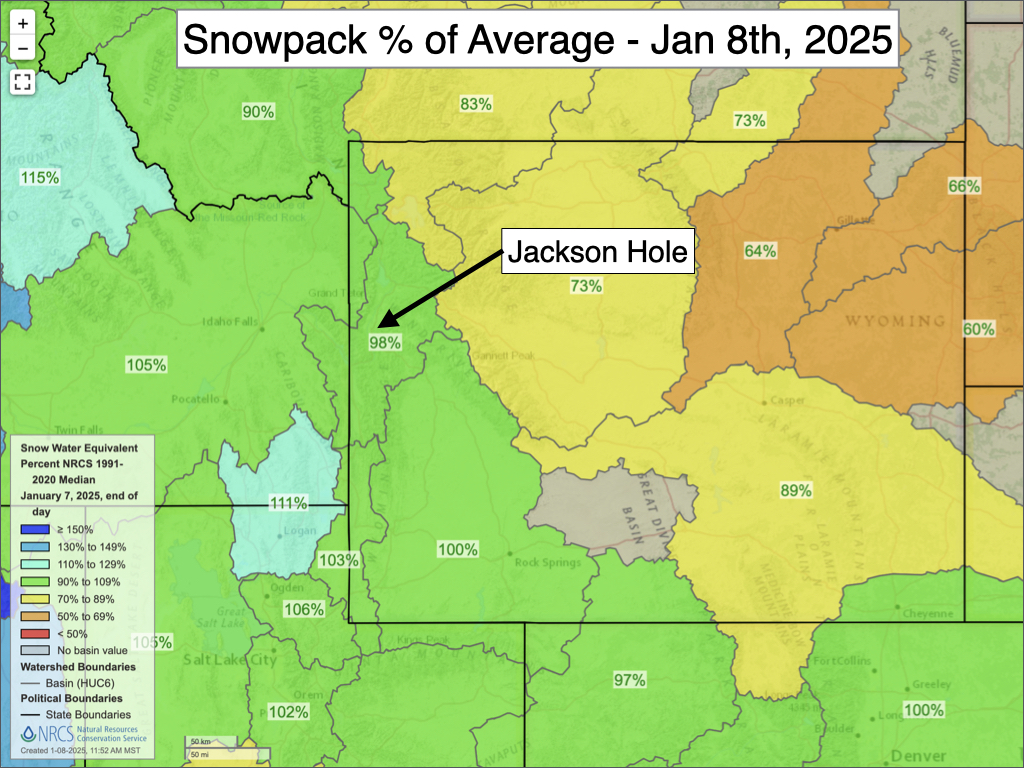
As of January 8, snowpack is now right around average in the Tetons and Upper Snake River Basin. Snowpack remains below average across Central and Eastern Wyoming.
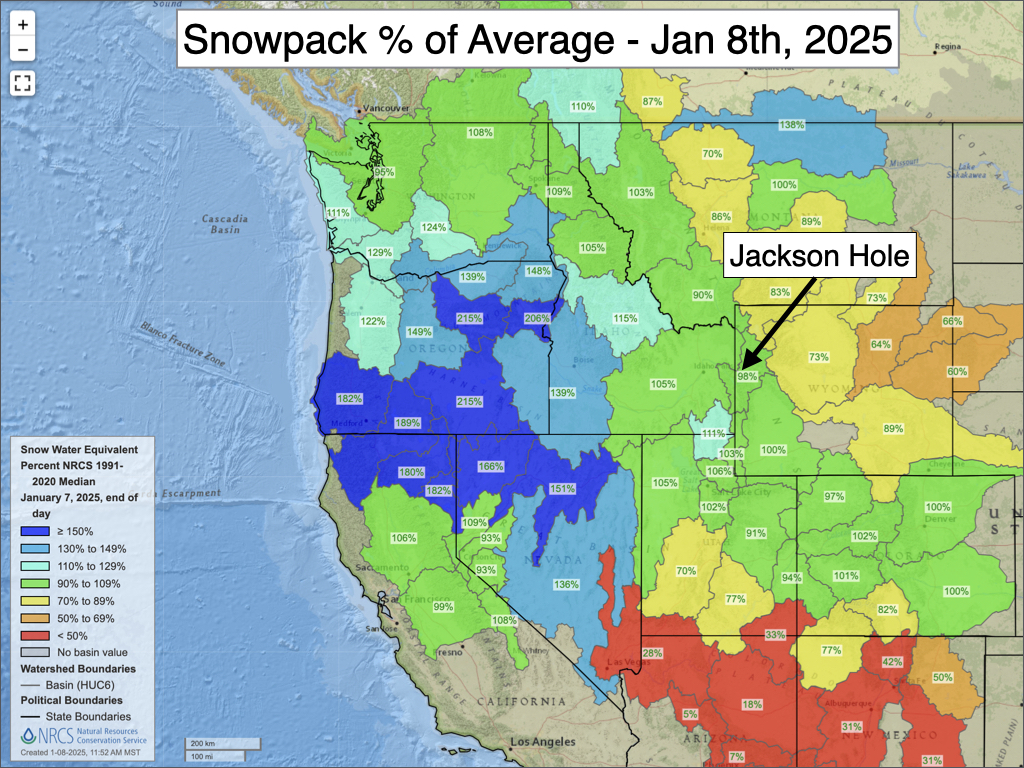
Across the West, snowpack is deepest (relative to average) in Oregon and Northern California/Nevada, while a generally healthy snowpack exists across the Pacific Northwest and in the Northern/Central Rockies west of the Continental Divide.
Snowpack is well below normal across the Southwest U.S. where precipitation was minimal during the month of December. This includes Southern California which is currently experiencing devastating wildfires.
The next chart shows our snowpack (as measured by snow water equivalent, or liquid content of the snowpack) relative to average in the Upper Snake River Basin as a time series.
In mid-December, we were right around record low values since 1981, but since then, we have improved to near average.

Upcoming Weather Pattern
We have hit a bit of a lull in the pattern this week, though a minor disturbance is moving through on Wednesday afternoon with snow showers developing.
The snow forecast for Wednesday’s disturbance was minimal as the best moisture was projected to pass too far north and east of the area.
However, this snow shower activity seems to be more robust than expected so far, and we could end up with a couple of inches in the Tetons as a result.
After a break on Thursday, a stronger storm will arrive from the northwest late in the week with periods of snow expected from Friday night through Saturday. This storm could produce another 6-12 inches across the higher elevations of the Tetons.
A cold front will arrive at the leading edge of the weekend storm, and a cold airmass will be in place for the duration of the event, leading to a dry powdery snowfall that will make for excellent skiing conditions on Saturday.
Prevailing winds will be out of the west to northwest with this event, which will once again lead to light snowfall in the Jackson Hole Valley, especially around the town of Jackson.
While minor accumulations are likely in town, accumulations will be higher in Driggs and Victor, and to a lesser extent, the West Bank (Wilson to Teton Village) where more spillover will occur compared to further east in Jackson.
After this storm, we could see a follow-up weaker disturbance on Sunday with snow showers possible. Then a drying trend is expected starting on Monday.
Here is a 7-day snowfall projection representing the average of 50 simulations of the European weather model.
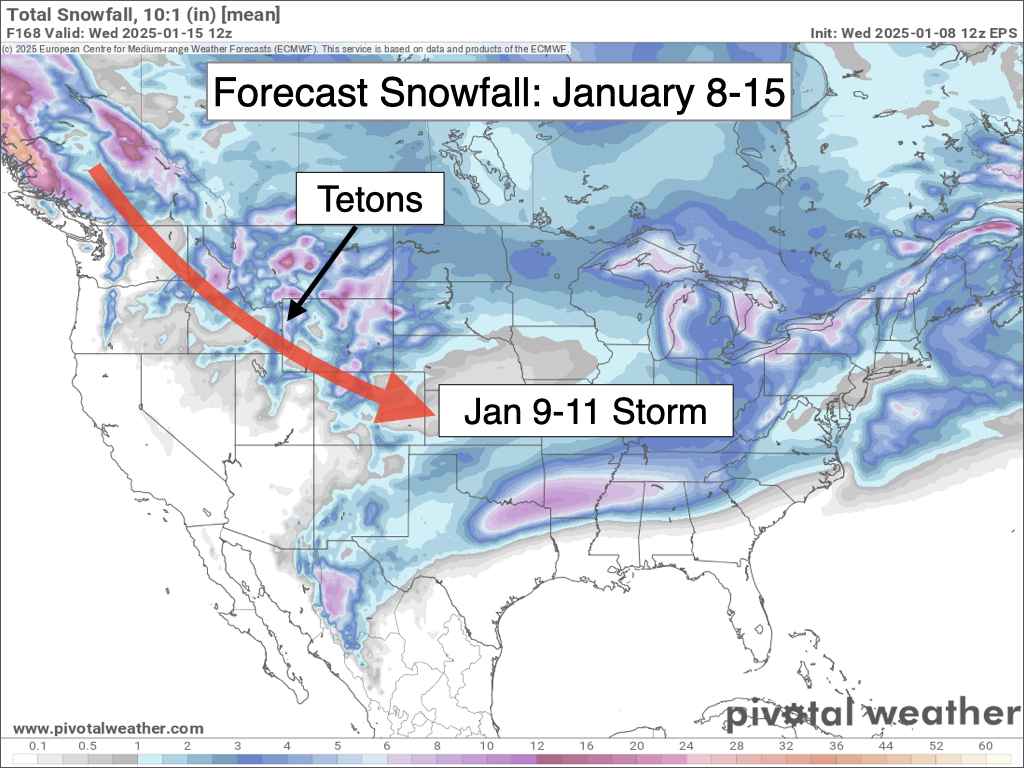
The Tetons will see most of it’s snowfall over the next 7 days from January 9-11 in association with the weekend storm.
Nationwide, it will be an active week with snow expected across large swaths of the country, including the Southern U.S.
Looking further out, the pattern from January 13th-17th is looking dry as a ridge of high pressure strengthens over the Western U.S., acting as a barrier to storms.
Temperature inversions will become common in this pattern with cold temperatures in the Jackson Hole Valley while the higher elevations will see a warming trend over time.
Beyond the 17th, we may head into a somewhat more unsettled pattern as high pressure shifts slightly westward to near/just offshore the Pacific coast. This pattern would favor a colder northerly flow with occasional shots of snow possible.
However, we will need to see the high pressure ridge shift further west away from the coast in order to see more frequent and/or stronger storms and there are no signs of this happening just yet.
Alan Smith, Meteorologist