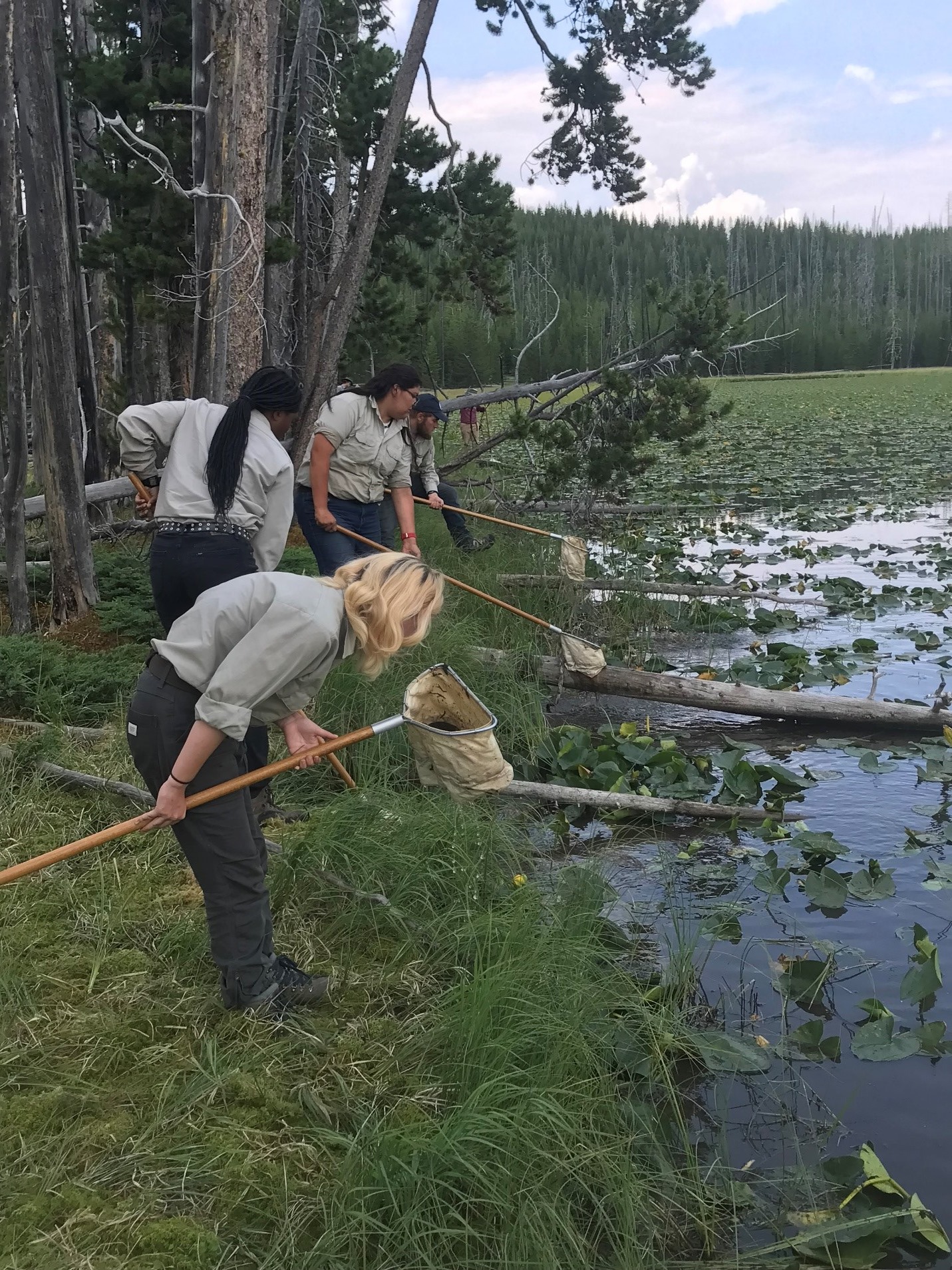
YELLOWSTONE, Wyo. —This summer, high school students from Yellowstone’s Youth Conservation Corp and Groundwork USA helped park managers better understand the health of Yellowstone’s ecosystem through the Dragonfly Mercury Project, a cooperative research project between the National Park Service, the US Geologic Survey, and the University of Maine.
Park staff and the students wielded dip nets to gather dragonfly larvae from four Yellowstone water bodies.
The predatory dragonfly larvae can live in the water for several years before transforming into the more familiar colorful, winged, adult stage. These long-lived larvae eat other invertebrates and even small fish, resulting in the bioaccumulation of mercury in their bodies. The mercury levels in the larvae are an indication of the overall mercury level of their habitat.
Mercury is a toxic pollutant that can harm humans and wildlife. Mercury often enters parks as air pollution from distant, human-caused sources, like coal-burning power plants, though in Yellowstone, mercury can also be introduced naturally from thermal springs. Understanding where high concentrations of mercury exist is one way to understand and protect the health of public lands like Yellowstone.
The studies conducted by students were permitted through a research permit.