JACKSON, Wyo. — Based on a network of traps located across the valley, Teton County Weed and Pest (TCWP) directly linked weekly mosquito counts to whether or not property owners opt into its preventive treatment program, which entails using a drone to distribute a “pre-emergent larvicide.”

TCWP Entomologist Mikenna Smith told Buckrail that the time period that the species of “nuisance mosquitoes” are at their worst is typically mid-to-late June, while the vector-borne species of mosquitoes that carry the West Nile virus typically peak in August.
“While overall numbers are down in August, it’s our highest risk right now for West Nile virus,” Smith said.
Smith said that Wyoming sees cases of West Nile every single year, although activity of the virus in mosquitoes, birds, horses or humans has not been detected in Teton County since 2023. Smith noted, though, that there is a high degree of asymptomatic cases, with approximately 8 out of 10 people not presenting any symptoms.
Since mosquito counts for the season are still being tallied, Smith shared some ballpark data with Buckrail from June, July and early August. As of Aug. 6, TCWP trapped 55,038 mosquitoes in Teton County for the season so far. Last year’s total summer count was 62,064 mosquitoes. The nine-year average for mosquitoes caught per night in Teton County is 192.
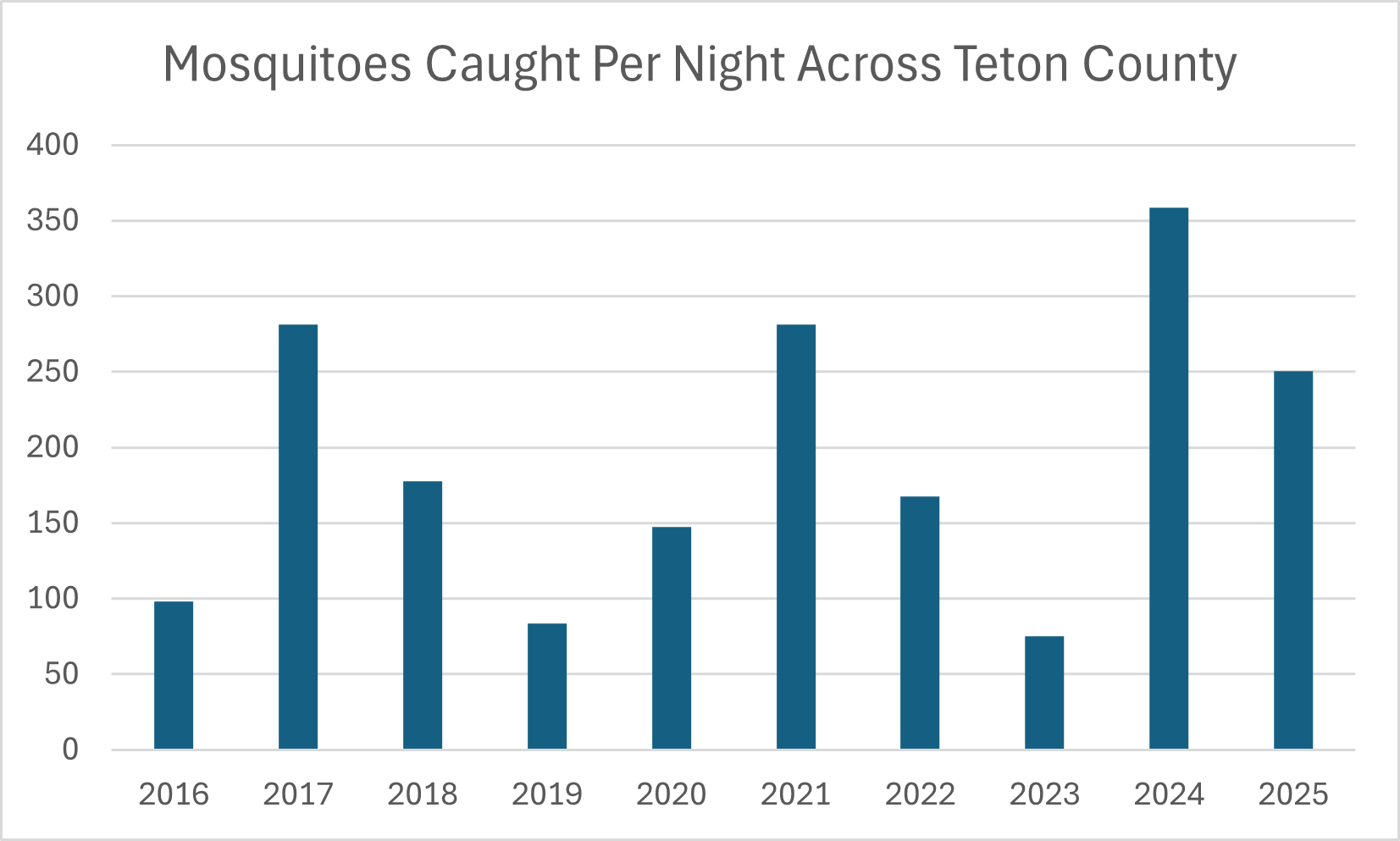
For the town of Jackson, so far in 2025, the average number of mosquitoes trapped per night has been 451 compared to 2,917 trapped per night last year, where town meets the National Elk Refuge (NER). Near Karns meadow, the average number of mosquitoes trapped per night has been 769 compared to 2,697 trapped per night last year.
“Across the board, mosquitoes were usual in some places and unusual in others,” Smith said. “In areas that we can access, we were able to address mosquito breeding before it turned into a problem. We hit the Buffalo Valley area and some ranches around Jackson pretty heavily with this pre-treatment program.”

Smith said that the Buffalo Valley, a region north of Moran Junction near the Bridger-Teton National Forest, had unusually low mosquito activity compared to previous years. Conversely, the NER area, Rafter J and the South Park neighborhoods had their “usually” high number of mosquitoes. Smith said that mosquitoes on the NER did not top last year’s “record high” of “close to 10,000 in one night, for two to three weeks in a row,” but traps still caught approximately 5,000 a night. East Jackson was also hit with large swaths of the traveling pests, due to its proximity to the NER, according to Smith.
“Overall, I would say the data does show a high mosquito year compared to some others, but that it is pretty site specific,” Smith said.
Smith said that high mosquito counts are a result of lack of landowner permission to access the area. TCWP was not authorized to treat most of land in and around Rafter J, or the wetlands on the NER.
“We have some areas where we have a lot of ability to get in and do our work, and some areas where we kind of have a black hole of access,” Smith said. “Our hands are kind of tied when we can’t get in to do preventive treatments. We could be way more effective if we had more participation.”
To mitigate mosquitoes early, Smith said that crews need to access large areas where breeding can occur. She emphasized that ditches with standing water, ponds, irrigated hay fields and wetlands, such as the Karns Meadow, are areas that TCWP has used “environmentally friendly” larvicides to target mosquitoes.
Smith said that large-scale agricultural pesticides used in other parts of state have created a fear of pesticides.
“There’s a lot of chemo-phobia that people experience in this day and age,” Smith said. “People think ‘pesticide’ and they think ‘bad,’ they think ‘dangerous.’”
Smith emphasized that 99% of TCWP’s applied treatments are larvicides. TCWP mainly uses a bacterial larvicide, specific to only mosquitoes, and when larvae ingest the bacteria in water, they are poisoned from the inside. Smith stressed that the treatment, which degrades quickly in the environment, is “extremely safe” for humans and is non-toxic to mammals.
“It’s very, very selective to mosquitoes, especially at the dose,” Smith said. “Mosquitoes are very sensitive to it. When they put that out, it has no significant impact on other aquatic invertebrates.”
Occasionally, TCWP will use an “ultra low volume” adulticide, which is sprayed into the air to target adult mosquitoes in dense vegetation. According to the Centers for Disease Control and Prevention (CDC), when used according to product label instructions, adulticides do not harm people, pets or the environment. However, the CDC wrote on its website that certain precautions need to be taken to minimize risks to non-target organisms like bees and fish.
“The adulticides, unlike the larvicides, are not specific to mosquitoes,” Smith said. “They are called broad spectrum, so they can toxify other insects. But, we put it out at a dose that is too small to toxify larger insects, and we also treat after dusk when pollinators are not active.”
Smith explained that TCWP uses a “precise science” to apply an adulticide that quickly degrades (within hours) into the non-toxic gases of carbon and hydrogen for the health of the environment.
“It’s kind of like a quick wam, bam,” Smith said. “It knocks the mosquitos down when they are actively flying.”
TCWP’s mosquito treatment program is tax payer funded. TCWP also has an educational campaign to inform people on how to reduce mosquito breeding on their property.