


A bill to repeal mandatory net-metering for residential and small business rooftop-solar power generation and reform the program for those grandfathered in squeaked by the Senate Corporations, Elections and Political Subdivisions Committee Thursday.
Senate File 92 – Small customer electrical generation, sponsored by Sen. Cale Case (R-Lander), advanced on a 3-2 vote after more than two hours of debate and public comment.
The measure would repeal a current state statute that requires regulated utilities to credit or pay residential and small business customers for surplus electricity — generated from their personal rooftop solar panels — that’s redirected onto the grid for use elsewhere in the system. The repeal would go into effect July 1, 2024. Net-metering arrangements would be honored until July 1, 2039 for customers with solar panels installed by the repeal date.
The bill would also give authority to the Public Service Commission to determine net-metering compensation rates and allow utilities to potentially tack on extra charges for rooftop solar customers remaining in the system.
Similar attempts to reform or limit net-metering have failed, most recently in 2021. The impetus for renewing the effort is a concern that net-metering is subsidized by customers without rooftop solar power, according to Case.
Essentially, customers with rooftop solar arrays end up paying less than those without because they require less electricity from the system. That means customers with solar systems are not paying their fair share to cover a utility’s system-wide infrastructure costs, such as power plants and power lines, according to Case.

Without reforms, the uneven cost-share between those with and those without rooftop solar will only intensify as more people add small-scale, personal solar systems, Case said.
Senate File 92 “is about trying to make the whole system sustainable, in a green sense and a financial sense,” he said.
Critics say there’s no merit to his argument, and that an analysis of net-metering in Wyoming shows a shared cost-savings benefit to all customers, according to a 2022 study.
“We’re being told that those who don’t consume enough energy [from] the grid are somehow wrong and costing others,” Fremont County resident Steff Kessler told the committee. “I believe in freedom of choice to be more energy independent and freedom to save money on electricity bills and to be thrifty without getting punished for it.”
Net-metering in Wyoming
Interest is growing among Wyoming homeowners and businesses to offset their electric bills while reducing their carbon footprint by installing solar panels, according to Scott Kane, co-owner of Lander-based Creative Energies, which installs solar energy systems.
About 1,400 households in Wyoming have installed solar panels since 2017, according to Kane’s analysis of U.S. Energy Information Administration data. Installed residential solar capacity stood at 10.5 megawatts in 2021, which represents about 0.5% of all residential electric consumption in the state.
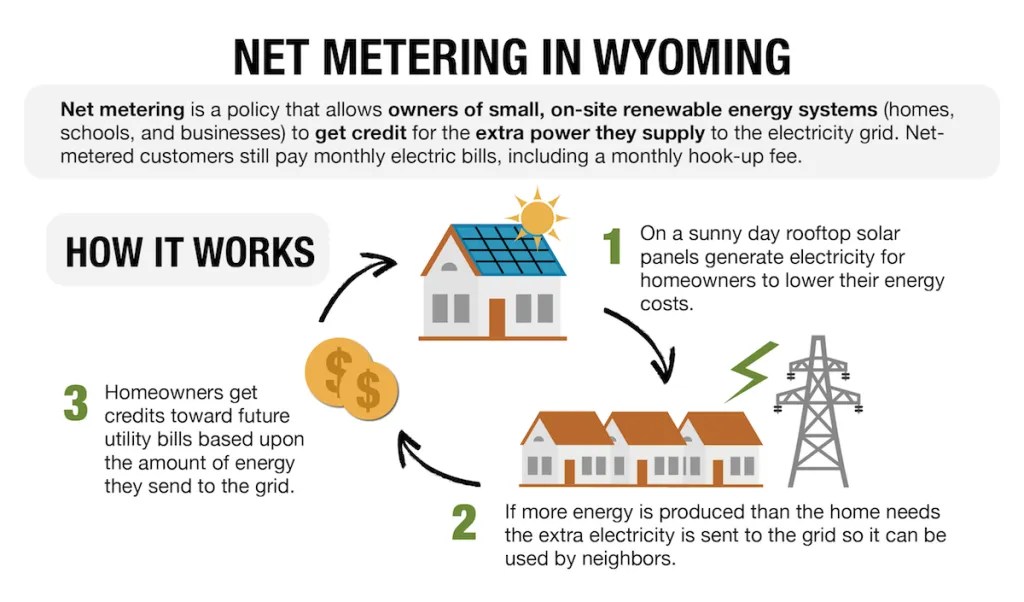
Currently, regulated utilities in the state are required to credit or pay customers with rooftop solar for the volume of electricity they direct back into the system for other customers to use. They are paid “retail value” for the energy — or the same rate that the utility charges other residential customers for that energy.
There’s only so much electricity that a single household can sell back into the system, according to Kane. It’s rare that a rooftop solar household will produce 100% of its electrical power needs for an entire year. For example, a solar-powered home may generate 100% of the power it needs, and a bit extra to sell back into the system, during sunny summer months. But other months, especially during short winter days, they typically require more power than the home solar system can generate.
If a home does push more electricity back into the system than it consumes in a year, the customer earns a smaller, “avoided cost” net-metering rate for that extra volume.
“That’s a good safeguard already in place to prevent people from over-producing, from trying to make money off the utility by being a little power plant,” Kane said.

Solar-powered homes are simply pulling less electricity from the grid on a yearly basis, making more energy available throughout the system.
“It’s a good, simple system,” Kane said.
Case, however, says it’s unfair that rooftop solar customers earn the retail rate for electricity they push into the system. Two Wyoming electric utility representatives agreed there is a slight disadvantage for non-rooftop solar customers when it comes to shared-system costs. However, neither they nor Case could quantify it.
Rooftop solar study
Anticipating another attempt at limiting net-metering in Wyoming, the Powder River Basin Resource Council, Wyoming Outdoor Council and the Wyoming Chapter of the Sierra Club commissioned a study in 2022. The study, conducted by Crossborder Energy, examined the systemwide and ratepayer impacts of net-metering among three Wyoming utilities and determined it “does not cause a cost shift to non-participating ratepayers.”
In fact, small rooftop solar in Wyoming is a net-benefit to all ratepayers, according to the study.
“We’re being told that those who don’t consume enough energy [from] the grid are somehow wrong and costing others.”
Stef Kessler, Fremont County resident.
For example, the addition of residential power generation reduces the scale of expensive new industrial power generation — coal and natural gas power generation stations, as well as intermittent wind and solar farms — necessary to replace aging infrastructure. It also helps reduce a utility’s fuel and power purchases during peak-demand periods (extreme heat or cold) when those commodity prices spike.
The study also indicated that potential growth in rooftop solar creates sustainable local jobs and promises “quantifiable societal benefits” by reducing planet-warming carbon emissions and reducing air pollution.
Although slight and difficult to measure in Wyoming, rooftop solar is beneficial to all customers, the bill’s opponents say. Senate File 92, if passed in its current form, would leave it up to utilities to decide if they want to offer a net-metering program beyond July 1, 2024. If they don’t, their customers wouldn’t be able to afford to invest in residential solar arrays, according to Claire Deuter, renewable energy organizer for the Powder River Basin Resource Council.
“This bill removes a major incentive for rooftop solar and leaves our solar industry high and dry,” Deuter told the committee. “I understand that the purpose of this bill is to prevent subsidization, but we oppose this bill because we don’t see subsidization currently occurring in Wyoming.”
WyoFile is an independent nonprofit news organization focused on Wyoming people, places and policy.










