JACKSON, Wyo. – A storm on Monday produced 1-2 feet of snow in the Tetons, including an intense stretch on Monday night in which Targhee picked up 11 inches in 3 hours. Another strong and longer-duration snow event is expected Thursday night through Saturday.
Recent Storm Recap
The first of two major storms this week impacted the Tetons on Monday (February 26), though preliminary impacts in the form of high winds were experienced ahead of this storm last Saturday and Sunday (February 25-26).
Why was it so windy?
The was a sharp temperature gradient (also known as a cold front boundary) associated with this storm with well-above-average temperatures ahead of the front and well-below-average temperatures behind the front.
Temperature and pressure are directly related, and the tighter the pressure gradient (the change in pressure with horizontal distance), the faster the wind will blow – because air moves from high pressure to low pressure.
The storm eventually reached the Tetons during the day on Monday. The duration of the event was relatively short, but the rate of snowfall was very intense with 1-2 inch per hour rates across the Tetons for much of the event.
Peak wind gusts during the storm on Monday included 65 mph at the Surprise Pinnacle station near Surprise Lake in Grand Teton National Park, 59 mph at the top of the tram at JHMR, and 38 mph at the Jackson Hole Airport.
Temperatures were above freezing in the Jackson Hole Valley for most of the day on Monday and snow had trouble accumulating as a result. The cold front moved through the area on Monday evening and as temperatures dropped, the Jackson Hole Valley picked up 2-3 inches of new snow, while Snow King received 5 inches.
The most remarkable part of this event happened on the west side of the Tetons just after the cold front moved through.
A brief period of extremely heavy (but low density) snowfall developed on the west side of the Tetons behind the front, with Targhee picking up 11 inches of snow in 3 hours (from 10 p.m. to 1 a.m.) and 12 inches of snow in 4 hours (from 10 p.m. to 2 a.m.).
This was a sustained period of 3-4 inches per hour snowfall rates – an extremely intense rate of snow!
In total, Grand Targhee’s Chief Joseph Bowl Plot at 8,800 feet picked up 16 inches of snow on Monday night and a total of 24 inches of snow in 24 hours from Monday morning through Tuesday morning. Snow from this storm also easily buried the 16-inch tall snow stake at the base of Targhee.

Targhee’s short burst of heavy snow on Monday night likely resulted from a few factors.
First, a period of strong atmospheric dynamics kicked in just behind the cold front while there was still an abundance of moisture available. Second, winds became lighter and shifted to west/northwest behind the front which is favorable for terrain-enhanced lift (known as orographics) on the west side of the Tetons.
And finally, a cold and unstable atmosphere took hold behind the cold front which is also favorable for the orographic effect to kick in. The cold air and lighter winds also supported high snow-liquid ratios, which translates to low-density “blower powder” which is wonderful to ski.
Jackson Hole Mountain Resort also did very well with this storm, picking up 13-15 inches at its upper mountain plots from Monday through Monday night. A higher portion of this snow fell ahead of the cold front, as JHMR did not experience the same extreme snowfall rates that Targhee did behind the cold front on Tuesday night.
Overall, this was an impressive storm for both sides of the Teton Range and skiing conditions have been outstanding this week.
A follow-up weaker disturbance arrived on Tuesday, producing another 2-5 inches of low-density snow in the Tetons and around an inch in the valley.
February Snow Totals
The winter season has turned around substantially this month with impressive snowfall totals for the Tetons and the Jackson Hole Valley.
In fact, many valley locations have received over 50% of their season-to-date snowfall just this month, and locations in the Tetons have received more than one-third of their season-to-date snowfall this month.
Here is the latest tally of monthly and seasonal totals. February clearly stands out from the rest of the pack.
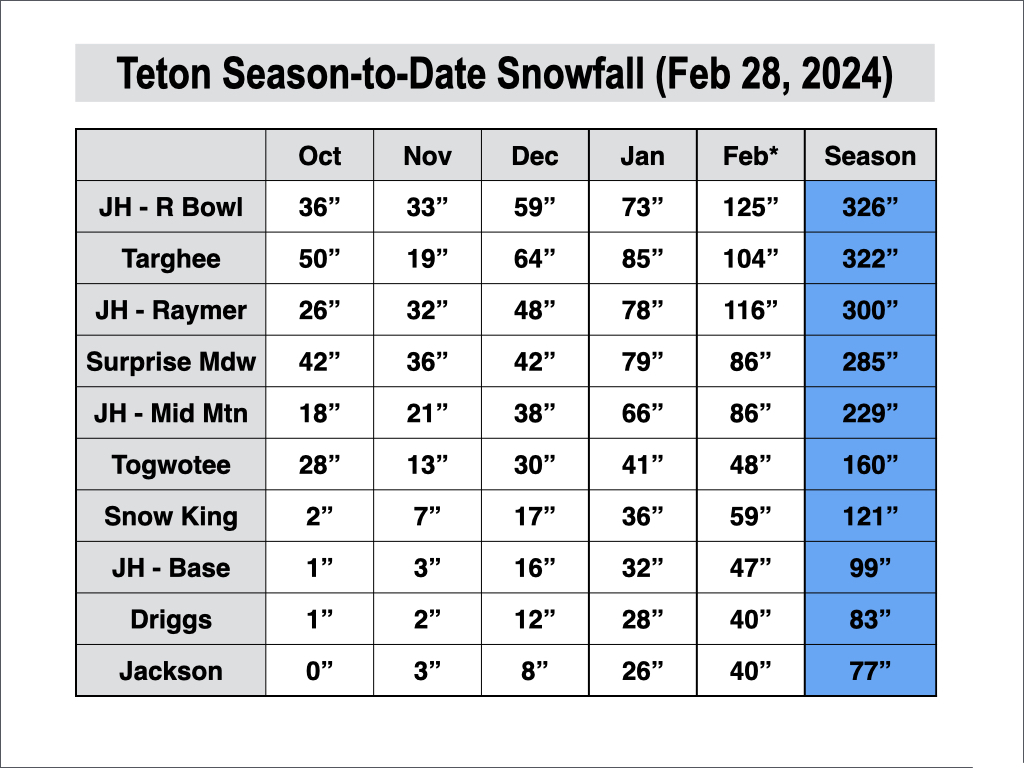
While last season was a much deeper winter in the Tetons overall, the 125 inches of snow recorded at JHMR’s Rendezvous Bowl Plot was higher than any single month last season. In fact, this was the snowiest month at the Rendezvous Bowl Plot since February 2021 when 171 inches fell.
At Grand Targhee, 104 inches fell this month which is very impressive but “only” ranks as the snowiest month since March 2023 when 128 inches of snow was recorded.
For the town of Jackson, monthly totals include 34.6 inches at the official climate site near the visitor center, and 39.6 inches in East Jackson (Cocorahs WY-TT-40 location). This ranks as the snowiest single month in town since January 2020 when 35.6 inches fell at the official climate site.
The Moran/Jackson Lake weather station has recorded 68.5 inches of snow this month, making this the snowiest single month since February 2019 when 76.2 inches was recorded.
Snowpack (as measured by snow water equivalent) continues to improve and is now 88% of average in the Upper Snake River Basin, which includes the Tetons and surrounding ranges. For perspective, we were around 60% of average in early January.

Strong Storm Ahead Late This Week
Another major storm cycle will impact Jackson Hole and the Tetons from Thursday night through Saturday.
Ahead of the storm, we will see a significant warm-up on Thursday with high temperatures rising into the low 40s in the valley. Winds will also become strong out of the southwest. Light snow showers will develop during the daytime hours on Thursday, with a rain/snow mix possible in the valley on Thursday afternoon.
Snowfall rates will gradually pick up in the Tetons on Thursday night, becoming heavier and more widespread late in the night. Temperatures will stay mild overnight with above-freezing values in the valley, resulting in a rain/snow mix.
Heavier and more widespread snow can be expected from Friday through Friday night with temperatures also trending colder as a slow-moving cold front moves through early in the day. The valley will see mostly snow on Friday, but it will probably not begin to accumulate down low until late afternoon or early evening on Friday.
Snow will continue through the first part of the day on Saturday with a stronger cold front moving through during the afternoon. Heavy snow is likely as the front moves through, with more intermittent snow showers on Friday night.
Winds will remain strong up until the front passes, then will become lighter on Saturday afternoon and Saturday night.
This will be a high-impact storm from a travel perspective, with impacts beginning over Teton Pass by early Friday morning, while the valley roads will begin to deteriorate on Friday evening (just in time for the afternoon/evening commute).
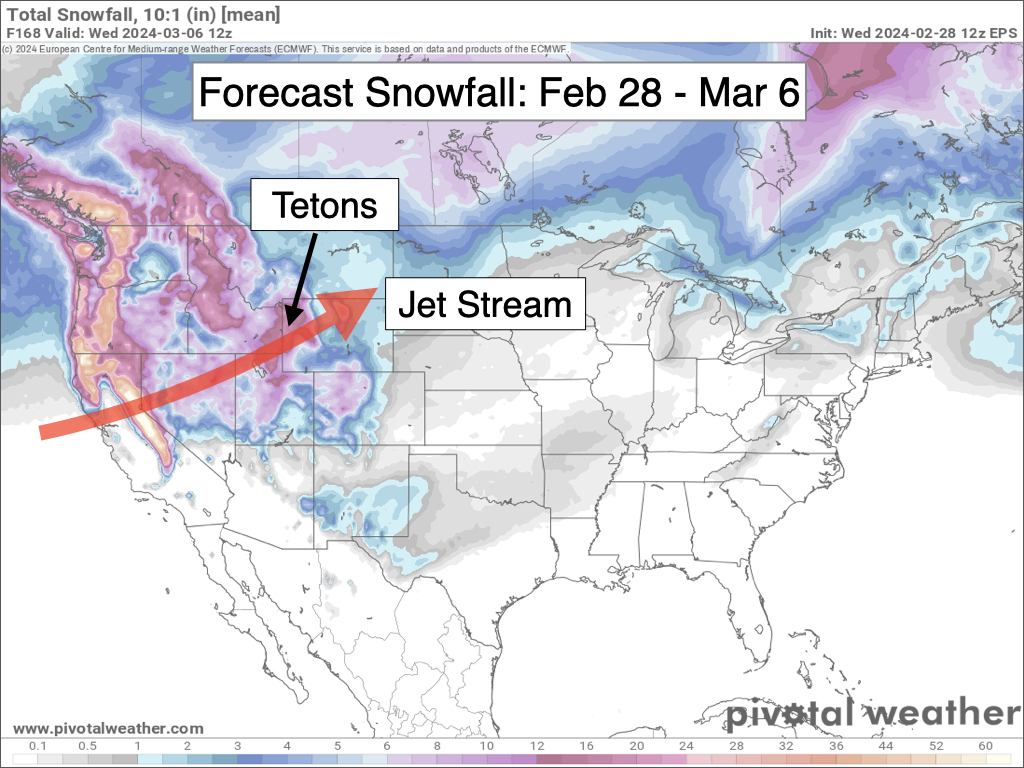
A follow-up weaker storm is likely on Sunday with light to moderate snow expected. Winds will be lighter during this storm, but temperatures also colder, resulting in a low-density snow event.
Skiing conditions will be outstanding through the weekend, though high winds could impact lift operations through early Saturday afternoon, and opening delays are also possible at times due to avalanche control.
We will likely see a break in the pattern early next week, then snow chances return around mid-week (March 5-7) as a storm approaches from the Pacific Northwest. This storm looks weaker than previous storms and there is some uncertainty as to whether or not the storm tracks favorably toward our area, or if it passes too far south.
Snow chances aside, temperatures are expected to be colder than average throughout the week of March 4-10 with highs projected in the low to mid 30s in the valley most days.
Alan Smith, Meteorologist